

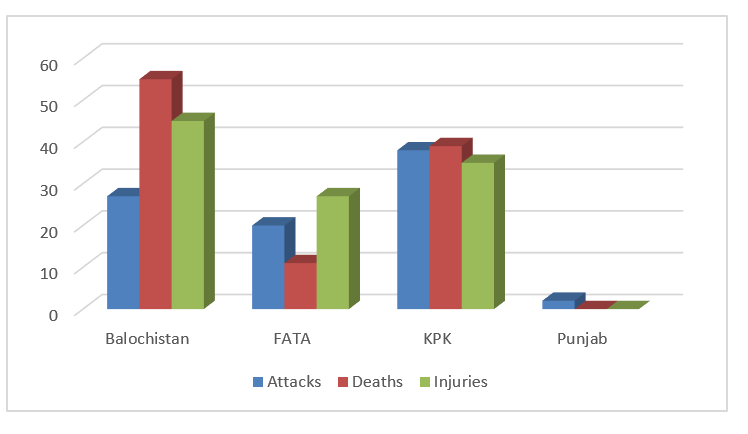
After a reduction in December 2025, militant violence increased in January 2026, with 87 attacks recorded nationwide compared to 68 the previous month, marking a 28 percent increase. These attacks resulted in 105 fatalities and 107 injuries. While early-year spikes in violence follow a familiar pattern, January stood out for the leading role played by Baloch militant groups, particularly the Balochistan Liberation Army (BLA), which conducted coordinated attacks across Balochistan in the final days of the month.
Counterterrorism operations remained intense, with security forces conducting 48 major actions in January, killing 220 militants. These operations also resulted in the deaths of 15 security personnel and 21 civilians. A significant shift was the concentration of CT activity in Balochistan, where 159 militants were killed—92 of them on 31 January during and after coordinated BLA attacks. Security forces also killed 35 militants in KP, 20 in the former FATA, and six in Punjab. Ongoing sanitisation operations in Balochistan indicate that the state intends to respond to the insurgent resurgence with sustained force.
The planned security operation in Tirah Valley exposed deep federal–provincial fractures over counterterrorism policy in KP. While security officials described the evacuation—eventually displacing over 70,000 residents—as jirga-approved, temporary, and necessary due to militants using civilians as shields, the KP chief minister publicly rejected the operation, accusing the centre of unilateral decision-making, harassment during registration, and failure to release funds for internally displaced persons. Despite clear local fatigue with militancy and shrinking social space for armed groups, political contestation, fiscal disputes, and civil–military coordination gaps risk undermining the legitimacy and effectiveness of counterterrorism efforts.
Counterterrorism discourse became deeply politicised as KP leadership questioned official narratives regarding Afghan-based militancy, triggering sharp federal backlash accusing the province of ambiguity and underfunding CT institutions. This coincided with a broader opposition mobilisation under Tehreek Tahafuz Ayeen-i-Pakistan (TTAP), which adopted a dual-track strategy combining parliamentary engagement with street agitation. With opposition leaders assuming formal roles in both houses while simultaneously planning nationwide protests, political polarisation has intensified, complicating security management and economic governance.
Economically, Pakistan stands at a critical juncture as policymakers seek to move from IMF-driven stabilisation to export-led growth. A high-level review identified high energy costs, distorted taxation, regulatory fragmentation, and policy unpredictability as core structural barriers keeping exports stuck at USD 30–35 billion despite far higher potential. While macro indicators—improved growth projections, rising reserves, and monetary stability—signal short-term resilience, officials acknowledge that without deep reforms in energy pricing, taxation, SOEs, and trade facilitation, sustained competitiveness will remain elusive. Persistent security challenges and political instability further constrain long-term growth prospects.
Pakistan’s defence profile continued to evolve. Rising international interest in the JF-17 Thunder—linked by senior officials to its performance during the May 2025 India–Pakistan confrontation—signals shifting global defence market dynamics toward cost-effective, non-Western platforms. Interest from Indonesia, Bangladesh, Iraq, and Saudi Arabia, alongside Azerbaijan’s induction of the aircraft and China’s alignment with exports, positions the JF-17 as a commercially viable asset strengthening Pakistan’s defence industry and strategic partnerships.
Defence modernisation accelerated through indigenous capability development. The successful test of the Taimoor air-launched cruise missile enhanced the PAF’s precision-strike and conventional deterrence, while advances in indigenous unmanned surface vehicles highlighted a growing naval emphasis on asymmetric and autonomous warfare. Military leadership reinforced this trajectory by articulating a doctrine prioritising multi-domain operations, cyber, electronic warfare, and integrated air–land–sea capabilities.
Regionally, Pakistan hardened its public stance on Afghanistan, accusing the Afghan Taliban of enabling cross-border militancy and portraying Afghanistan as a hub for groups including TTP, ISKP, al-Qaeda, and ETIM, while keeping limited diplomatic channels open. Islamabad acknowledged cross-border strikes, framed border closures as a security necessity, and internationalised its concerns with support from China. Relations deteriorated further due to collapsing trade, Afghanistan’s ban on Pakistani medicines, large-scale repatriation of Afghan nationals, and symbolic incidents such as jihadist rhetoric at militant funerals in Kabul. Yet, Saudi-facilitated backchannels, Taliban pressure on militant groups to limit cross-border activity, and cautious signals from both sides suggest tentative exploration of de-escalation, contingent on verifiable counterterrorism action.
Pakistan also warned that India’s decision to place the Indus Waters Treaty in abeyance constitutes “weaponisation of water,” threatening agriculture, livelihoods, and regional stability. Islamabad accused New Delhi of treaty violations, unnotified regulation at Baglihar Dam, and withholding hydrological data amid Pakistan’s acute water scarcity and climate vulnerability. The signing of a UAE–India Strategic Defence Partnership added a geopolitical dimension, particularly against the backdrop of Pakistan’s accusations of Indian support to militant groups in Balochistan.
Strategic partnerships continued to evolve. Pakistan and Saudi Arabia expanded defence cooperation through training, exercises, and talks on converting Saudi loans into a potential multi-billion-dollar JF-17 deal. Reports of Türkiye seeking to join the Pakistan–Saudi defence framework point toward a possible trilateral security arrangement, though sensitivities between Riyadh and Ankara complicate progress.
Pakistan-Bangladesh ties improved notably, with high-level defence talks focusing on training, maintenance, air defence integration, and possible JF-17 induction. Direct flights resumed, reflecting broader diplomatic normalisation. Pakistan–China relations remained a cornerstone, with both sides reaffirming zero tolerance for terrorism, agreeing on “visible and verifiable” action against militant groups operating from Afghan soil, institutionalising quarterly security coordination, and advancing CPEC 2.0 across economic, technological, and security domains.
Pakistan-Indonesia engagement advanced toward structured cooperation, marked by defence talks, growing Indonesian interest in JF-17s, drones, and air defence systems, and the establishment of a Joint Trade Committee aimed at expanding trade beyond USD 4 billion and positioning Indonesia as Pakistan’s gateway to ASEAN.
Pakistan’s decision to join President Trump’s US-led “Board of Peace” on Gaza marked a significant diplomatic shift but triggered intense domestic backlash from opposition parties, religious groups, provincial assemblies, and militant outfits. While the government argues participation allows Pakistan to influence humanitarian and political outcomes without recognising Israel or deploying troops, concerns over the board’s governance, Trump’s sweeping authority, and contested multilateral legitimacy have deepened internal polarisation.
Pakistan-US relations reflected a dual-track dynamic: a hardening US immigration posture, including suspension of immigrant visa processing, alongside renewed security cooperation through training programmes, joint exercises, and defence upgrades. Islamabad responded cautiously while pursuing quiet diplomacy. Pakistan also reaffirmed its commitment to de-escalation regarding Iran, rejecting disinformation about alignment with US or Israeli action and emphasising diplomacy, regional stability, and avoidance of spillover risks into Balochistan.