
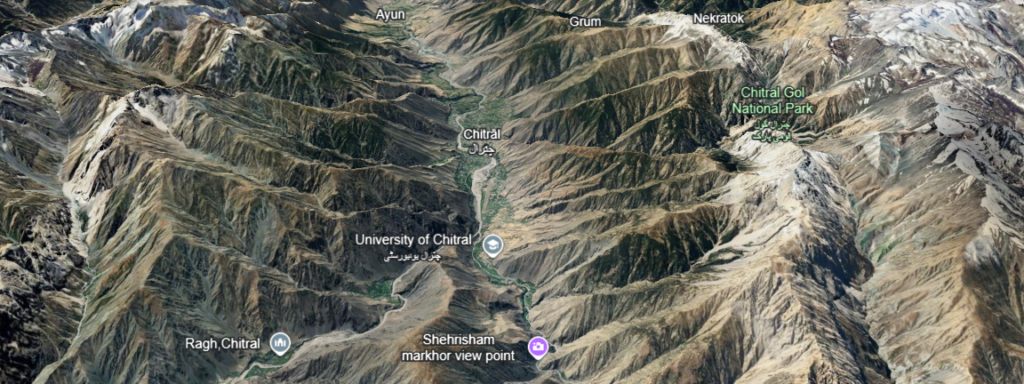

Chitral, long regarded as one of the most peaceful regions of Khyber Pakhtunkhwa, is facing a growing threat from terrorism and cross-border militancy, raising serious concerns about the future of peace and stability in this strategically important region. The long-standing conflict between Pakistan and Afghanistan has spilled over into the region, threatening its peace and stability. A series of incidents over the past few years has contributed to the shift in the security landscape of the region. In February 2026, during the military confrontation with the Pakistani forces along the Pak-Afghan border, the Taliban forces opened fire on the Arandu region of Lower Chitral on February 26, injuring six people and displacing around 3,542 individuals (545 families) to Drosh Valley. The attack spread fear among the people and prolonged the already strained security environment. Pakistani forces retaliated which resulted in the blockade of roads into Kadesh district of Nursitan province of Afghanistan. A ceasefire was reached in a jirga held on April 15, 2026, attended by the elders from both sides, following which the families returned to their homes and resumed their normal routines. Later, on June 29, 2026, Tehreek-e-Taliban Pakistan (TTP) claimed to have captured a security post in the Arson area of Drosh Tehsil in Lower Chitral. According to the South Asia Terrorism Portal (SATP), six Security Forces personnel were killed, nine were injured, and one was abducted in the attack. In june Taliban forces again bombed some areas near Garam Chashma. The shells landed at empty sapces. Later, in a statement, the Taliban’s Defence Ministry claimed that the Taliban air force had conducted air strikes on the alleged positions of Islamic State and anti-Taliban groups in the Garam Chashma area of Shah Salim Valley in Chitral. However, the claim was not backed by any independent verification. Pakistani authorities said that the allegations by Taliban regime are meant to deflect attention from the presence of TTP and other terrroirst groups on Afghan soil.
The current security concerns can be traced back, in part, to the September 6, 2023, attack carried out by TTP. According to reports by the Pakistan Institute for Conflict and Security Studies (PICSS), the attack was carried out in the southern part of Lower Chitral. Two security check posts in Astui Pass and Jinjirat Koh, bordering Afghanistan’s Nuristan province, were targeted. Four soldiers and nine militants were killed, and five soldiers along with 42 militants were injured in the attack. This incident was followed by further military actions that took place on September 10, 2023, in Ursoon and in Lachagai Gol on September 30, 2023. There were three more attacks in 2025, resulting in the deaths of one militant and one soldier, while three schoolchildren were injured in total.
Pakistan accuses Afghanistan of providing safe haven to the militant groups that carry out terrorist activities inside Pakistan. At the same time, Afghanistan denies the claims and alleges that Pakistan is sheltering and training anti-Taliban groups. According to the Afghan Taliban, Pakistan is reportedly using Chitral as a launching pad to carry out attacks inside Afghanistan. In this ongoing conflict between the two neighboring countries, Chitral, a traditionally peaceful region of Pakistan, is facing security threats.
Chitral, located in the Hindu Kush mountains, shares an international border with Nuristan and Kunar provinces of Afghanistan to the west, and the narrow Wakhan Corridor in Badakhshan province to the north. The physical geography of Chitral and its proximity to Afghanistan, a nation in prolonged instability, are contributing to the rise in security concerns in the region. The mountainous terrain, high-altitude passes, and narrow valleys of Chitral make surveillance difficult. In contrast, this same topography facilitates militant movement across the border from Afghanistan into Chitral. Chitral, traditionally perceived as a relatively peaceful and secure region, is now exposed to armed infiltration and security threats. Volatility in the neighbouring regions, including Kamdesh district of Nuristan and Zebak district of Badakhshan in Afghanistan, is undermining the stability of Chitral. This is evident from the clash between Taliban forces and the Afghanistan Freedom Front (AFF) on September 26, 2026, in Kamdesh. Following the attack, Taliban police claimed that Pakistan had sent 300 to 400 young Afghans across the border to carry out the attack. However, AFF denied these accusations and claimed that it had captured some parts of Kamdesh district from the Taliban and all their fighters were local Afghans. Before that, the AFF attacked the Taliban posts in Zebak district on July 23, 2026, and claimed to have killed 21 Taliban members and wounded 37 others. Confirming the attack, the Taliban stated that the attack involved infiltration from Chitral in Khyber Pakhtunkhwa. These incidents are increasing the risks of military engagements affecting Chitral, deepening instability and security concerns in the region.
Moreover, to the south of Chitral lies Upper Dir, which also faces militancy and terrorist activities. Recently, on September 17, 2026, two volunteers of a local lashkar were killed in Dobando near the Pakistan-Afghanistan border in a gunfight with militants. In another incident, an exchange of fire between police and militants continued for two days on August 12 and 13, 2026, in the mountainous Bariot Darbanu area. These incidents show the volatility of the area south of Chitral, making infiltration of militants into Chitral possible. The ongoing security issues in the surrounding regions are not merely a few days of violence and chaos; instead, they threaten the established peace and future prospects of Chitral.
The security threats to Chitral expose a critical vulnerability because of their multiple impacts on the region, the inhabitants, and the country at large. Chitral has the potential to serve as a link between Pakistan, Afghanistan, China, and Central Asia. The Wakhan Corridor, which connects Afghanistan and China, lies immediately to the north of Chitral, increasing its strategic importance. Recently, Afghanistan has opened a 121-kilometre unpaved road linking the country with China. This development offers Chitral an opportunity to connect with emerging regional networks, providing a potential route for the movement of people, goods, and trade between Pakistan, Afghanistan, China, and Central Asia. However, Chitral’s emerging potential needs protection from insecurities such as terrorism, militancy, and military engagements. Otherwise, the country risks losing future opportunities associated with the region.
Moreover, due to growing militancy in Chitral, the state is carrying out more defensive measures and counter-terrorism initiatives in the region. Although these measures are intended to improve security, deploying security forces, building military infrastructure, introducing sophisticated weapons, and carrying out military activities may result as new challenges to the region’s established social order. The people of Chitral are not familiar with these activities, and their repeated exposure to such engagements may normalise violence for them. In such a case, there is a risk that militant recruitment could easily draw members of the Chitral community into violence. Additionally, these activities can also divert attention from essential developments, including road infrastructure, healthcare, disaster preparedness, and education, which are urgently needed in Chitral. This cycle of retaliation is costing the peace of Chitral, its untapped potential, and its vibrant, cohesive community.
Furthermore, the religiously inspired militant groups, intolerant of other religions, portray themselves as enforcing Sharia law in Pakistan. Therefore, their increasing presence in Chitral is particularly concerning for the Ismaili and Kalash communities of the region. This is because the militant groups accuse the Ismailis of deviating from their interpretation of Islam. They have previously targeted the Ismaili community in the Safoora Goth bus incident in Karachi on May 13, 2015. A bus carrying Ismailis was attacked by armed militants, killing 47 people. In another incident, a TTP-affiliated video surfaced in 2014 warning the Kalash tribe to embrace Islam or face death. The militant groups have displayed hostility towards the Kalash community, and they have continued to intimidate the community for maintaining its non-Muslim identity. The proximity of Kalash Valley to Afghanistan further increases the region’s security sensitivity. Consequently, militant attacks in Chitral are also concerning with respect to the diversity and peaceful coexistence of the people.
Chitral is also recognised as a popular tourist destination. Every year, thousands of people from Pakistan and abroad visit Chitral to experience Kalash culture, to witness the Shandur Polo Festival, and to explore other tourist spots such as Garam Chashma (hot springs). Many people in Chitral benefit from tourism through hotels, transport services, guiding, and handicrafts. The growing visibility of Chitral on social media could also attract more tourists to the region. This could strengthen the region’s potential to become a tourism hub, creating further development and employment opportunities. This is beneficial for both the local population and the wider economy of the country. However, increasing security concerns in the region can discourage visitors, interrupt tourism, and jeopardise these revenue streams.
Taken together, the expansion of the militant groups’ activities in Chitral is a growing threat to the region’s peace, harmony, and security. The increasing vulnerability to security issues is threatening the region’s traditional identity, undermining the existing security framework, and compromising its future prospects. Chitral requires the attention and commitment of the authorities to implement timely security measures that can preserve its long-standing peace.
—-
The writer is a graduate of International Relations from University of Peshawar. Currently working as an intern at Pakistan Institute for Conflict and Security Studies (PICSS).