
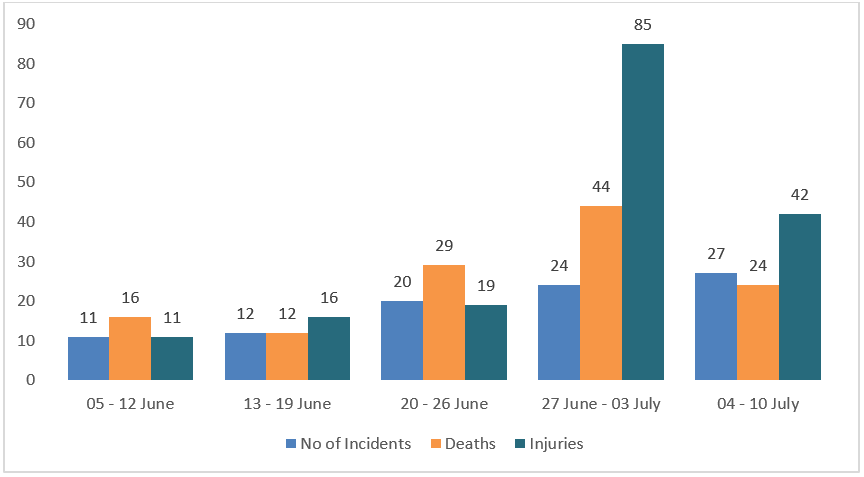
During the week of 4–10 July 2025, Pakistan experienced a surge in militant activity, with 27 attacks resulting in 24 fatalities (including five security personnel and 19 civilians) and 42 injuries, despite an overall decrease in intensity compared to the previous week. Balochistan reported the highest number of incidents (13), followed by KP (11) and erstwhile FATA (3), with tactics ranging from tactical assaults and targeted killings to IEDs, grenade, and drone attacks. In response, security forces conducted 10 intelligence-based operations, killing 23 and arresting two suspected militants. The banned Balochistan Liberation Front (BLF) claimed announced “Operation Baam” claiming to have carried out 70 attacks.. While many of these claims remain unverified, the abduction and execution of nine Punjabi passengers in the Sur-Dakai area stood out as the deadliest incident, highlighting the group’s operational intent and reach.
Tensions in KP’s tribal belt escalated as large-scale protests in North Waziristan opposed potential military operations, with locals citing past displacement and destruction from the 2014 Zarb-e-Azb campaign. Simultaneously, unrest deepened in Bajaur after ANP leader Maulana Khan Zeb was assassinated while campaigning for peace, sparking violent demonstrations. Adding to the discontent, resistance emerged against the Mines and Minerals Bill, perceived as undermining local control over resources. In response, CM Ali Amin Gandapur initiated a multi-party dialogue process to defuse tensions and engage stakeholders.
Imran Khan, after meeting PTI leaders in Adiala Jail, rejected any prospects of dialogue and announced a nationwide protest campaign culminating on August 5, the anniversary of his arrest. Labeling the current government as illegitimate and judiciary as compromised, Khan called for peaceful protests akin to a “second Pakistan Movement” and warned party leaders against internal dissent. While his sister Aleema highlighted the harsh prison conditions faced by Khan and his wife Bushra Bibi, doubts remain about PTI’s ability to mobilize effectively due to leadership fragmentation, organizational disruption, and protest fatigue. The movement’s scale and impact will hinge on whether PTI can translate public sympathy into sustained street power.
Tensions between Pakistan and India have sharply intensified amid mutual accusations of proxy warfare, nuclear threats, and regional destabilization. Pakistan criticized India’s defense buildup and rejected allegations of nuclear blackmail, while senior military leaders blamed India’s NSA Ajit Doval for supporting TTP and Baloch militants. In turn, India warned of a China-Pakistan-Bangladesh strategic axis and emphasized full-spectrum preparedness. Pakistan’s top brass, including COAS Gen Munir, dismissed Indian claims of foreign support in recent military operations and reiterated Pakistan’s nuclear deterrence. Meanwhile, the U.S. reaffirmed its role in maintaining regional ceasefires, contradicting Indian narratives. The impasse is exacerbated by India’s reluctance to revive SAARC, though Pakistan remains committed to regional cooperation. Without renewed diplomatic engagement, the region faces the prospect of prolonged instability between two nuclear-armed rivals. China has lauded the Pakistan Air Force (PAF) for its strategic performance during recent conflicts with India, deepening military collaboration with Pakistan. During a high-level visit to Islamabad, China’s PLAAF Chief Lt Gen Wang Gang praised the PAF’s operational efficiency and multi-domain integration, expressing interest in learning from its wartime experience. Meetings between Chinese and Pakistani air chiefs focused on enhancing cooperation in training,technology, and joint operations. Both sides emphasized indigenous capability development using Chinese platforms, with future collaboration expected in fighter jets, early warning systems, and joint exercises. The visit signals stronger military alignment amid regional tensions and reflects the shared strategic outlook of the two allies.
Pakistan and Turkiye are expanding their strategic partnership through reinforced defence cooperation and broader collaboration in trade, energy, education, and infrastructure. At the High-Level Strategic Cooperation Council meeting, both countries agreed to boost defence industry links, revive critical infrastructure like the Istanbul-Tehran-Islamabad train, and promote Turkish investment in Pakistani economic zones. Discussions included energy ventures, joint aerospace projects, and a push to elevate bilateral trade to $5 billion. High-level meetings between Turkish ministers and Pakistani leadership signaled mutual commitment to regional stability and strategic alignment. This renewed engagement, driven by shifting geopolitical dynamics, reflects both countries’ intent to institutionalize a resilient and multidimensional partnership.
Pakistan and the United States reached a breakthrough understanding on a critical trade agreement aimed at avoiding the reimposition of high tariffs on Pakistani exports ahead of a looming July 9 deadline. Led by Commerce Secretary Jawad Paal, the negotiations secured reciprocal market access, preserving U.S. demand for Pakistani textiles and agricultural goods while paving the way for increased Pakistani imports of U.S. crude and investments in energy and mining sectors. Strategic projects like Reko Diq were highlighted, and officials expect the deal to help reset economic ties strained during the Trump era. The finalized agreement, pending U.S. clearance, is seen as vital for stabilizing Pakistan’s export markets and attracting foreign investment.
Pakistan and Russia are bolstering their strategic and economic ties through high-level engagements and major projects, including the revival of Pakistan Steel Mills (PSM) with Russian technical assistance. Officials from both countries signed agreements in Moscow to revamp the once-vital industrial asset, while also pushing forward regional connectivity initiatives like the trilateral railway with Uzbekistan. Russia’s Deputy PM Overchuk emphasized Pakistan as a strategic partner, and plans are underway for a Putin-Sharif meeting at the SCO summit. Both sides also discussed developments in Afghanistan and South Asia, aiming to enhance industrial, trade, and infrastructure cooperation amidst shifting global alignments.
Afghanistan’s Taliban-led government is navigating a complex diplomatic terrain, gaining Russia’s formal recognition for its counterterrorism efforts while facing global criticism for human rights violations. The UK acknowledged some success against ISIS-K, but the UN passed a resolution condemning the regime’s treatment of women and lack of inclusivity. Meanwhile, the Taliban secured investment and trade commitments from Central Asian states and signed a $500 million railway deal with Kazakhstan, as China also ramped up infrastructure projects. Despite regional engagement, international legitimacy remains elusive, further strained by ICC arrest warrants for top Taliban leaders. Pakistan resumed formal talks with the Taliban but remains alarmed by the continued presence of anti-Pakistan militant groups on Afghan soil, highlighting a dual-track approach of cautious engagement and international pressure.