
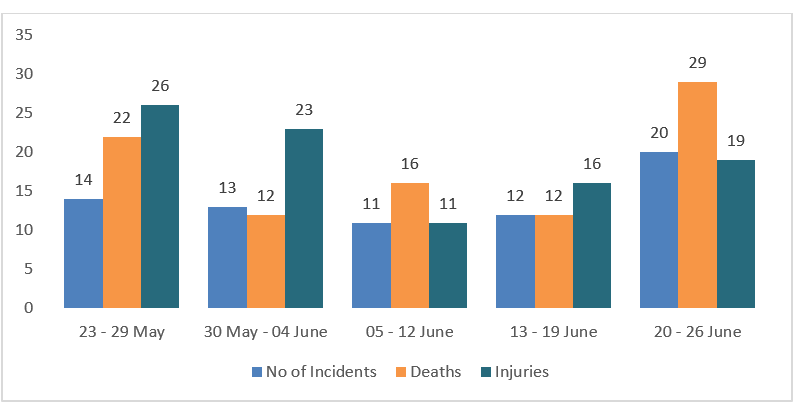
Pakistan witnessed a sharp uptick in militant violence during the week, with 20 attacks—up 66% from the previous week—resulting in 29 deaths and 19 injuries. Balochistan was the epicenter, with KP and ex-FATA also witnessing significant activity. Tactics included IEDs, targeted killings, and drone strikes. In response, security forces launched four operations, killing 16 militants and arresting 10 RAW-linked operatives.
Political turbulence persisted as PTI faced legal and internal challenges. The Lahore High Court’s rejection of Imran Khan’s bail plea in the May 9 cases added to party troubles, while KP CM Gandapur’s surprise budget approval sparked backlash and exposed internal factionalism. A divide continues between PTI’s political pragmatists and confrontational hardliners, with leadership rivalries in KP further paralyzing the party’s direction.
The federal government moved to revive the traditional jirga system in KP, forming a high-level committee led by Amir Muqam and Law Minister Azam Nazeer Tarar. The initiative—triggered by tribal elders’ demands—aims to complement the formal justice system, especially in underserved areas, though concerns remain over due process and human rights. Broader justice system reforms have been called for in parallel.
On the economic front, signs of stabilization emerged as China agreed to reschedule $1.8 billion in debt, easing pressure on Pakistan’s forex reserves and helping meet IMF programme targets. Investor confidence surged, with the PSX recording its second-highest single-day gain, while the Consumer Confidence Index rose 9.2%. Parliament passed a Rs17.57 trillion budget, introducing tax reforms, social safety net enhancements, and anti-smuggling measures. Foreign reserves are projected to hit $13.9 billion by June-end, but progress remains contingent on political stability, fiscal discipline, and further debt rollovers.
A major counter-intelligence operation dismantled a suspected RAW network, with four arrests in Karachi and six in Punjab. In Punjab, authorities seized explosives and intercepted communications detailing planned attacks; in Karachi, suspects were caught spying on military and CPEC sites. The arrests underline escalating sub-conventional threats and growing regional intelligence rivalries.
Amid Middle East tensions, Pakistan moderated its stance on US-Israeli strikes on Iranian nuclear sites, aligning more with Gulf states and avoiding direct criticism of Washington. The NSC condemned attacks as violations of international law without naming the US. Pakistan offered to mediate between the US and Iran, joined China and Russia at the UN in calling for de-escalation, and coordinated diplomacy with Gulf allies. Iran’s President thanked PM Shehbaz Sharif after a US-brokered ceasefire, reflecting Islamabad’s efforts to maintain strategic neutrality and diplomatic relevance.
At the SCO meetings in China, India-Pakistan tensions flared. NSA Ajit Doval blamed Pakistan for terrorism, citing LeT and JeM, while Pakistan’s NSA Asim Malik accused India of backing violence in Balochistan and KP. Defence Minister Khawaja Asif reiterated concerns over foreign involvement in domestic attacks and linked peace in Gaza, Kashmir, and Afghanistan to broader stability. India’s refusal to endorse a joint communiqué led to its collapse—highlighting how bilateral hostilities obstruct multilateral cooperation. Additional tensions arose from Indian threats to revoke the Indus Waters Treaty and UN allegations tied to the Pahalgam attack.
The government’s decision to nominate Donald Trump for the Nobel Peace Prize drew criticism in the National Assembly. Opposition parties questioned the decision’s legitimacy, especially given Trump’s controversial Middle East legacy. The nomination came amid warming US-Pakistan ties, marked by Trump’s praise of COAS Asim Munir’s role in defusing regional tensions and Secretary of State Rubio’s outreach on Middle East peace. The future of US-Pakistan relations remains unclear—whether they deepen beyond tactical cooperation or remain transactional.
Meanwhile, Afghanistan’s global standing is shifting as regional engagement grows and international scrutiny intensifies. The UK’s appointment of a special envoy signals renewed European interest, while the UN and US remain critical of Taliban policies, especially on human rights and counterterrorism. The US passed legislation to block aid to the Taliban, while Pakistan pressed Kabul to act against the TTP and respect women’s rights at the OIC and UN. The Taliban highlight reduced opium cultivation and seek closer ties with China and Türkiye. Despite improved diplomatic ties between Islamabad and Kabul—facilitated by Chinese mediation—cross-border militancy, remain key challenge.