

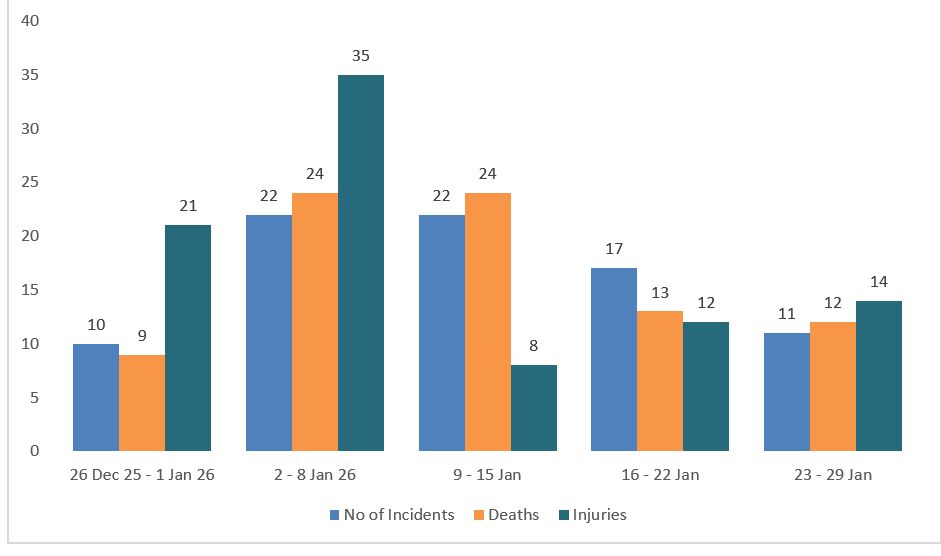
During the week of 23–29 January 2026, Pakistan recorded 11 militant attacks nationwide — a decline from 17 the previous week — resulting in 12 fatalities (3 militants, 9 civilians) and 14 injuries. Violence remained concentrated in western regions: Khyber Pakhtunkhwa (KP) experienced the highest intensity with 7 attacks (8 killed, 10 injured), followed by erstwhile FATA (3 attacks; 1 killed, 4 injured) and Balochistan (1 attack; no casualties but significant rail disruption). Tactical assaults (5) and IED incidents (4) dominated militant tactics, while a single suicide bombing in DI Khan killed 7 civilians and injured 7 others during a wedding.
Security forces maintained strong operational tempo, conducting 7 notable counter-terrorism operations that killed 16 militants and arrested 2, with KP (3 operations), Balochistan (2), and Punjab (2) seeing the most activity. Key actions included the elimination of senior TTP commander Ghafoor alias Ijaz and BLA local commander Farooq alias Soro, alongside large weapons recoveries.
Propaganda activity remained intense. TTP expanded outreach by releasing content in Bengali, signaling intent to recruit beyond Pashtun areas, and issued sharp condemnations of Pakistan’s participation in U.S. President Trump’s Board of Peace (BoP) for Gaza reconstruction, framing it as betrayal of the Muslim Ummah and threatening further confrontation. The group also exploited the Tirah Valley displacement issue to blame the military. ISPP released threats promising destruction of Baloch nationalist groups (BLA/BLF), while BLA’s Hakkal Media published a new ideological book by chief Bashir Zeb Baloch titled Mohkash. IMP and Jamat-ul-Ahrar similarly denounced the BoP move as alignment with “Crusader” and Zionist interests.
Domestically, Pakistan’s decision to join the BoP (announced 22 January at Davos) triggered widespread opposition from religious parties (JI, MWM), political forces (PTI, opposition alliances), and the KP Assembly, which passed a unanimous rejection resolution. Militant groups seized the issue to intensify anti-state narratives.
In Afghanistan, bilateral ties with Pakistan deteriorated further amid a 56% collapse in Pakistani exports, prolonged closure affecting stranded students at Torkham, and inflammatory anti-Pakistan rhetoric at a militant funeral in Kabul. The Taliban continued selective external engagement (Gulfood exhibition, UNHCR/ICRC coordination, prisoner talks with the US over Dennis Coyle) while accelerating internal consolidation through a new Criminal Code, tightened media controls, and expanded restrictions on women. Overall, the week reflected persistent but regionally contained militant pressure in Pakistan’s western borderlands, accelerated propaganda exploitation of the Gaza/BoP issue by TTP and affiliates, deepening Pakistan–Afghanistan mistrust, and incremental Taliban efforts to project governance stability amid humanitarian and economic strain. The combination of declining but stubborn attack levels, strong CT responses, and intensifying ideological/narrative warfare points to continued volatility along the western frontier in the near term.