
1. Executive Summary
This week, Pakistan experienced 22 militant attacks, resulting in 16 deaths and 16 injuries. The majority of these incidents occurred in Balochistan, which witnessed nine attacks, followed by six each in erstwhile FATA and KP, and one in Punjab. These attacks included physical assaults, targeted killings, grenade and IED explosions, and rocket attacks. Security forces conducted seven operations, resulting in the deaths of five militants and the arrest of twelve others.
Police protests in KP, sparked by attacks on officers and frustration over the deteriorating security environment, ended after assurances from authorities. The protests, which included road blockades and sit-ins in Lakki Marwat, Bannu, and Bajaur, were marked by demands for better resources and reduced military intervention in police duties. There might be possible future adjustments in security responsibilities, shifting more duties to the police amidst concerns over their capacity to manage the situation.
Political tensions in Pakistan remained high with chances of tussle getting uglier between the government and the judiciary and between judiciary and the establishment. The government’s inability to secure enough votes for the “Constitutional Package,” which includes proposals like fixing the Chief Justice’s tenure and creating constitutional courts, has caused embarrassment for the coalition government. JUI-F chief Maulana Fazlur Rehman’s rejection of the package and the ongoing PTI reserved seats issue reflect deep divisions between institutions.
Pakistan has expressed mounting frustration over the Taliban’s alleged support for the Tehreek-e-Taliban Pakistan (TTP), which has increased attacks on Pakistani soil. At a UN Security Council meeting, Pakistan’s representative highlighted evidence of the Taliban harboring TTP militants near the border, enabling cross-border attacks with modern weapons left by foreign forces. In a sign of frustration, authorities in Pakistan also removed Ambassador Asif Durrani as Pakistan’s special representative while an incident involving the Afghan Consul General in Peshawar surfaced that further strained relations.
China has reportedly proposed enhancing anti-terrorism cooperation with Pakistan by establishing a joint security company and a cooperation agreement to protect Chinese nationals and projects. China has also emphasized the need to incorporate security equipment projects into CPEC Phase-II and urged the completion of pending projects from the first phase, focusing on infrastructure, energy, and industrial development. Addressing security concerns, particularly threats to Chinese citizens, is crucial for the success of these initiatives.
Pakistan and Russia have reaffirmed their commitment to strengthening bilateral relations, focusing on trade, energy, and regional connectivity. They have noted significant trade growth and are considering a Free Trade Agreement (FTA) between Pakistan and the Eurasian Economic Union (EAEU). Energy cooperation, particularly in LNG and oil, is a key area of focus. Both countries are also exploring infrastructure projects to improve connectivity between Pakistan, Russia, Afghanistan, and Iran. Despite challenges like international sanctions on Russia and instability in Afghanistan, upcoming events like the SCO summit and the Pakistan-Russia Intergovernmental Commission provide opportunities to enhance cooperation in defense, security, and economic sectors.
2. Assessment of Violent Activities of the Week
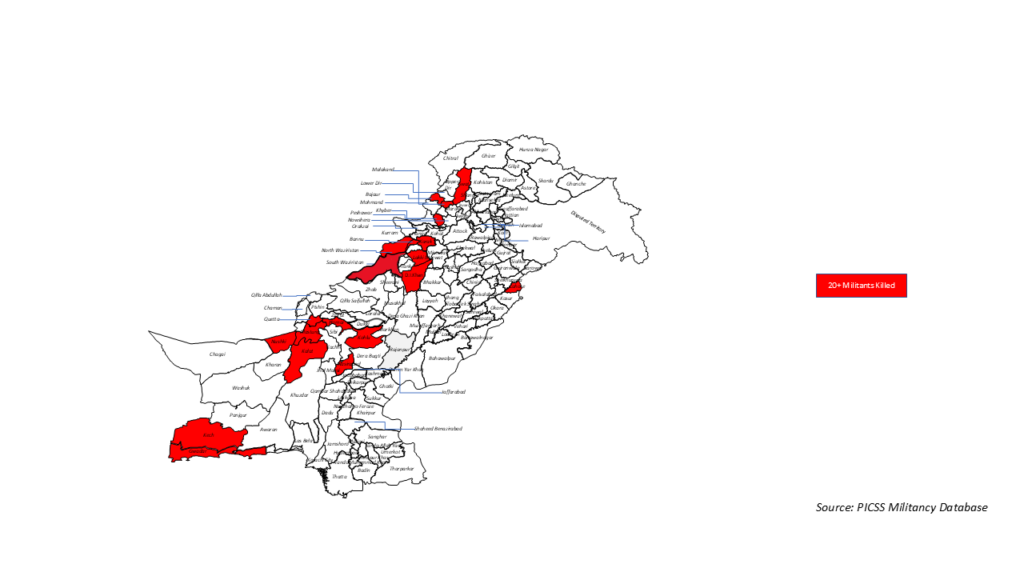
During the week under review, the country witnessed 22 militant attacks in which 16 people were killed and 16 others sustained injuries. Out of 22 militant attacks reported in the week, nine militant attacks were reported from Balochistan and six militant attacks each were reported from erstwhile FATA and KP while one incident was reported from Punjab. Among these 22 attacks, seven were physical assaults/guerrilla attacks and the same number of incidents of targeted killings; three grenade attacks and as many IED explosions and two incidents of rocket attacks. The country also witnessed seven security forces action in which five militants were killed and 12 others were apprehended. Break up of militant attacks, type of attacks, security forces actions, and affected districts is given in Tables 1-4, weekly comparison of attacks is given in Figure 1 while districts, where militants carried out attacks during the week, are shown in Figure 2.
Figure 1: Weekly Comparison of Militant Attacks
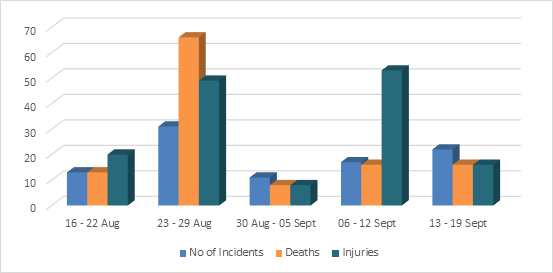
Figure 2: Map Showing Districts of Militant Attacks (13 – 19 Sept 2024)
| Region | No | Killed | Injured | Arst | Kdnp | ||||||||
| SFP | RZ | M | C | Total | SFP | RZ | M | C | Total | ||||
| Balochistan | 9 | 3 | 0 | 1 | 0 | 4 | 9 | 0 | 0 | 3 | 12 | 0 | 0 |
| FATA | 6 | 5 | 0 | 0 | 1 | 6 | 2 | 0 | 0 | 2 | 4 | 0 | 0 |
| KP | 6 | 2 | 0 | 3 | 0 | 5 | 0 | 0 | 0 | 0 | 0 | 0 | 0 |
| Punjab | 1 | 1 | 0 | 0 | 0 | 1 | 0 | 0 | 0 | 0 | 0 | 0 | 0 |
| Total | 22 | 11 | 0 | 4 | 1 | 16 | 11 | 0 | 0 | 5 | 16 | 0 | 0 |
| Type | No | Killed | Injured | Arst | Kdnp | ||||||||
| SFP | RZ | M | C | Total | SFP | RZ | M | C | Total | ||||
| MA | 7 | 4 | 0 | 0 | 0 | 4 | 2 | 0 | 0 | 0 | 2 | 0 | 0 |
| TK | 7 | 5 | 0 | 3 | 1 | 9 | 0 | 0 | 0 | 2 | 2 | 0 | 0 |
| GrA | 3 | 0 | 0 | 0 | 0 | 0 | 0 | 0 | 0 | 3 | 3 | 0 | 0 |
| IED | 3 | 2 | 0 | 1 | 0 | 3 | 9 | 0 | 0 | 0 | 9 | 0 | 0 |
| RA | 2 | 0 | 0 | 0 | 0 | 0 | 0 | 0 | 0 | 0 | 0 | 0 | 0 |
| Total | 22 | 11 | 0 | 4 | 1 | 16 | 11 | 0 | 0 | 5 | 16 | 0 | 0 |
| Region | No | Killed | Injured | Arst | ||||||||
| SFP | RZ | M | C | Total | SFP | RZ | M | C | Total | |||
| Punjab | 3 | 0 | 0 | 5 | 0 | 5 | 0 | 0 | 0 | 0 | 0 | 9 |
| FATA | 2 | 0 | 0 | 0 | 1 | 1 | 0 | 0 | 0 | 0 | 0 | 0 |
| Balochistan | 1 | 0 | 0 | 0 | 0 | 0 | 0 | 0 | 0 | 0 | 0 | 0 |
| KP | 1 | 0 | 0 | 0 | 0 | 0 | 0 | 0 | 0 | 0 | 0 | 3 |
| Total | 7 | 0 | 0 | 5 | 1 | 6 | 0 | 0 | 0 | 0 | 0 | 12 |
In Balochistan, militant attacks were reported from Dera Murad Jamali, Gwadar, Kalat, Kech, Kohlu, Mastung, Noshki and Quetta districts. In Kalat, eight security personnel were injured in a roadside explosion in Takhat area of on Friday. In Quetta, two police personnel including a sub-inspector were killed when their vehicle was targeted in a remote-controlled explosion on Ziarat road in Kuchlak area. The Islamic State’s Pakistan chapter (ISPP) claimed the responsibility. In another attack in provincial capital, armed men opened fire at the Levies official near Sariab Customs post in Quetta killing him on spot. In district Kohlu, unidentified armed persons targeted a cellular tower and set it on fire in the Bala Dhaka area. In Gwadar, suspected militants hurled a hand grenade at a bakery shop near airport road in the district. In Dera Murad Jamali, three labourers working at an electric grid station were injured when unidentified motorcyclist lobbed a hand grenade at them. In district Mastung, a hand grenade was lobbed into the office of the Motorway Authority. Three rockets were fired at a security agency’s office in Noshki, but they landed and exploded away from the target, causing no damage. In Kech, a militant got killed while planting an IED near khajoor market area in Turbat. In a security forces action, reported from Kech district, Bomb Disposable Squad (BDS) diffused an IED found near Abdul Haq chowk in Turbat area.
In erstwhile FATA, three security forces personnel lost their lives following an exchange of fire with the militants in North Waziristan tribal region. In another attack, reported from North Waziristan, a security man was killed in a sniper attack on a checkpost in Dattakhel area. A bank manager of the National Bank of Pakistan was also got killed and two others injured when gunmen opened firing on his vehicle in Mir Ali area of North Waziristan. In South Waziristan tribal region, a captain rank officer along with another soldier was injured when a bomb disposal unit came under fire by militants in Makeen area while a police officer narrowly escaped a sniper attack when he was travelling from Wana to Dera Ismail Khan. In another incident, armed men killed a policeman in Wana area of South Waziristan. In a security forces action. In a security forces operation, reported from South Waziristan tribal region, exchange of fire took place but without any human loss from either side and militants managed to escape.
In KP’s Bannu district, equipment for the construction of a road that has been halted for security reasons for a long time has been set on fire by unidentified men in Janikhel. In Peshawar, militants attacked the Regi Model Town police station with rockets on Sunday damaging its outer wall. The personnel deputed at the police station retaliated to the firing, forcing the miscreants to flee taking advantage of darkness. In district Karak, a Levies force official was gunned down by unidentified men while he was leaving his home for duty station this morning. In Lakki Marwat district, the house of a police officer was attacked in Kakhel area. After the initial exchange of firing, villagers from the nearby houses also fired at the militants forcing them to escape. In another attack, a retired military soldier was intercepted by unknown motorcyclists who checked his ID, questioned him and shot him dead in Ghaznikhel area of Lakki Marwat district. In a security forces action, reported from Swat, police recovered the bodies of three militants from a house in Pandrah Meel area.
In Punjab, a police constable was shot dead during exchange of fire with the militants at Sanda Road Islampura, Lahore. TTP claimed responsibility. In a security forces action, Counter Terrorism Department (CTD) Punjab killed three militants at Nankana interchange in Nankana Sahab district after exchange of fire during intelligence-based operation while two militants managed to escape. In DG Khan, a terror plot was thwarted and two suspected militants were killed during an intelligence-based operation in Sakhi Sarwar area by CTD. In another major operation, CTD on Saturday arrested nine suspected militants linked to banned outfits during operations in various areas of the province. The suspects belonged to banned groups, including Sipah-i-Sahaba Pakistan, Lashkar-i-Jhangvi and Daesh. The arrests were made during intelligence-based operations in Rahim Yar Khan, Okara, Bahawalpur, Lahore, Rawalpindi, Faisalabad and Mianwali.
| Province | District | SFAs | MAs |
| Balochistan | Dera Murad Jamali | 1 | |
| Gwadar | 1 | ||
| Kalat | 1 | ||
| Kech | 1 | 1 | |
| Kohlu | 1 | ||
| Mastung | 1 | ||
| Noshki | 1 | ||
| Quetta | 2 | ||
| FATA | North Waziristan | 1 | 3 |
| South Waziristan | 1 | 3 | |
| KP | Bannu | 1 | |
| DI Khan | 1 | ||
| Karak | 1 | ||
| Lakki Marwat | 2 | ||
| Peshawar | 1 | ||
| Swat | 1 | ||
| Punjab | DG Khan | 1 | |
| Lahore | 1 | 1 | |
| Nankana Sahab | 1 | ||
| Total | 07 | 22 | |
3. Significant Development(s) of the Week
3.1. Police Protests in Parts of KP Ended but Frustration Visible
In Lakki Marwat, police officials ended their four-day-long sit-in and opened the Peshawar-Karachi highway and other roads for vehicular traffic after the authorities accepted their major demands. Senior police officials and elders persuaded protesting officials to end their protest late on 12 Sep. “The authorities have assured us that there will be no compulsion on the police to launch action against armed groups,”; police would be provided with more armoured personnel carrier vehicles and other resources to enhance their professional capabilities; and security forces would be called back or confined to their camps. Policemen had set up a protest camp at Lt-Adnan Shaheed Square, popularly known as Tajazai Chowk, closing Indus Highway for vehicular traffic. In Bannu, the protesting police officials also ended their sit-in and handed over a charter of demands to the district police authorities. They had closed the Bannu-Miranshah Road after establishing the protest camp at Maulana Abdul Sattar Shah Bukhari Shah Chowk against the gun attack on a police constable, Jan Alam, in Domel area. Meanwhile, a sit-in Bajaur district staged by the police and local residents against attack, which left a policeman and a polio worker killed, ended in the evening on 13 Sep.[1]
The protests by policemen in various districts and places in KP have highlighted the ever present and growing frustration of policemen towards deteriorating security situation and killing of their comrades. In some places, the policemen chanted slogans against the military blaming it for rise in militancy. Local population and now policemen have shown apprehensions about movement of militants in the area and have been warry of the term Taliban who are raised to resist bad Taliban. Although social media was a buzz with reports that provincial government has withdrawn military and para-military from Lakki Marwat, no such notification was issued from the provincial government, so far. The visit of the Army Chief Gen Munir to Orakzai district on 13 Sep indicates that army leadership has been apprised of the situation on ground and there remains a possibility that paramilitary and military forces may be asked to curtail their security duty and manning of check posts in the rural areas and confine themselves to their stations/ camps allowing police to perform security duty and install check posts on roads and other places. Similar arrangements might be enacted in almost all southern as well as tribal districts though the capacity of police to shoulder this responsibility will be seriously tested.
3.2. Government Fails to Find Majic Number; Tussle between Institutions Intensifying
On 16 Sep, the Supreme Court office has questioned the release of a clarification order on its website regarding the Election Commission of Pakistan’s (ECP) failure to implement a July 12 ruling, which confirmed PTI’s eligibility for reserved parliamentary seats. The order, issued on September 14 by eight Supreme Court judges, warned the ECP of consequences for not fulfilling its obligations. However, the Deputy Registrar Judicial (DRJ) noted that no official cause list or notices were issued and said that clarification has been sought. [2] This has raised concerns about internal conflicts within the judiciary, potentially affecting the ECP’s notification of PTI’s 41 MNAs besides other things. In the meanwhile, National Assembly Speaker Ayaz Sadiq has challenged the Supreme Court’s ruling on reserved seats, arguing that recent amendments to the Election Act make the decision irrelevant. He sent a letter to the Chief Election Commissioner stating that the new law, passed on August 7, 2024, prohibits independent candidates from switching party affiliations post-election. Ayaz emphasized that the Election Commission must follow the amended law rather than the court’s earlier directive.[3]
On 18 Sep, JUI-F chief Maulana Fazlur Rehman has rejected the government’s proposed “Constitutional Package,” which includes amendments such as fixing the Chief Justice’s tenure to three years. The package was not presented in parliament due to a lack of consensus, with the JUI-F’s opposition being a key obstacle. Despite ongoing efforts to engage Maulana Fazl through backdoor channels, he criticized the draft, calling it unacceptable and a betrayal of the nation.[4] Although the government did not reveal the text of the package, the proposed Constitutional Package, includes amendments such as setting the Chief Justice’s term to a fixed three years. introducing changes to the Supreme Court and judicial council and setting up constitutional courts in the country. The government could not table the bill in parliament due to the ruling coalition’s inability to secure the necessary two-thirds majority for passage. The ruling coalition requires 224 votes in the National Assembly and 64 in the Senate to pass the amendments. Currently, they hold 213 confirmed seats in the NA and 52 in the Senate, relying on the support of key allies, particularly Maulana Fazl.
PTI is gearing up for its power show at Minar e Pakistan Lahore on 21 Sep.[5] The federal government informed the Islamabad High Court (IHC) that it is not considering a military trial for former Prime Minister Imran Khan. This statement was made by Additional Attorney General Barrister Munawar Iqbal Duggal during a hearing of Khan’s petition against a potential military trial related to the May 9 protests. However, Justice Miangul Hassan Aurangzeb asked the government to provide a clear response on the matter by 24 September.[6]
The last week was full of political activities in the federal as the coalition government was gearing up to get constitutional amendment passed from the parliament. However, the government failed to even introduce the bill in the parliament after failing to secure trust of the required magic number to get amendments passed from upper and lower houses. Despite efforts from the President Asif Zardari and PM Shahbaz Sharif personal efforts and meetings with JUI-F chief Fazal-ur-Rehman, the government could not get latter’s nod to join coalition parties for making changes in the constitution. The government kept the draft of the constitutional package confidential and did not make it public depriving general public, media and politicians to discuss the contours of the proposed amendment to see their efficacy. JUI-F chief is engaging both with the opposition PTI delegation as well as government delegations. Government is likely to come up with a lower minimum common agenda and amend the package accordingly to solicit response from JUI-F and other parties. Final or even intermediary outcome of the PTI’s reserves seats issue will have bearing on outcome of the constitutional amendment plan. Government is hell bent to stop PTI’s reserve seats adding up to PTI’s number while a section of judiciary sees it fit for PTI to have this number in a bid to stop government from making constitutional amendment(s). A section of judiciary, considered to be having soft corner for PTI founder Imran Khan, is believed to be aiding in Imran Khan’s tussle with the military establishment.
3.3. Pak-Afghan Developments: Pakistan’s Frustration Growing
Pakistan warned the international community about the threat posed by the TTP to Pakistan, region and the world. Pakistan’s permanent UN representative Munir Akram, addressing the United Nations Security Council meeting, said that Pakistan has evidence that some of the attacks inside Pakistan have been facilitated by elements in the Taliban government. “The TTP is a group of concern for Pakistan and should be of concern to the entire region and the world,” he said. He said that the Taliban has given shelter to TTP members near Pakistan’s borders, and that the group attacks targets in Pakistan almost every day from these areas. He said TTP has been equipped with modern weapons left behind by foreign forces in Afghanistan. Given the Taliban’s long relationship with al-Qaeda, it will not take long for the TTP to act as an agent of al-Qaeda in the region and the world, he said. “Although some friends are concerned about the threat posed by ISIS-K, they should also be concerned about the threat posed by the powerful TTP in the not-too-distant future,” he concluded.[7]
The Islamic Emirate of Afghanistan’s (IEA) Acting Minister of Refugees and Repatriation, Khalilur Rahman Haqqani on 18 Sep expressed concern over the treatment of Afghan refugees in Pakistan, calling for an end to forced deportations and harassment of the Afghan refugees.[8]
Ambassador Asif Durrani has been removed from his position as Special Representative on Afghanistan due to differences over Afghanistan policy. Reportedly, Durrani, who reported directly to the military and engaged with the Taliban and other countries involved in Afghanistan, faced dissatisfaction from military leadership regarding his performance, while also feeling increasingly frustrated as his policy advice was often ignored. He felt like an outsider in the Foreign Office, particularly due to his unique assignment that limited his participation in broader Afghanistan-related discussions. Appointed in May 2023, Durrani aimed to address the stalemate in Islamabad-Kabul relations, especially concerning TTP sanctuaries in Afghanistan. Despite his efforts, progress was minimal, and TTP attacks increased. Durrani had advocated for a balanced approach towards Afghan visitors and cautioned against mass deportations, emphasizing the need for Pakistan to manage its domestic terrorism challenges. His strict military oversight constrained his diplomatic effectiveness, ultimately leading to his removal. [9]
Lately, relations between Pakistan and Afghanistan were further strained after recent incident. The controversy began when Afghan Consul General Hafiz Mohibullah Shakir remained seated during Pakistan’s national anthem at a Peshawar event organized by the provincial government and attended by Chief Minister Ali Amin Gandapur, sparking outrage and accusations of disrespect. Pakistan’s Foreign Office condemned the act as a violation of diplomatic norms, while the Afghan Consulate defended Shakir, stating that he remained seated due to the music in the anthem, which goes against Afghan policies. Pakistan officially rejected this explanation and lodged a protest, emphasizing the importance of respecting diplomatic protocols. The issue created a lot of noise on electronic and social media showing anger but CM KP Ali Amin Gandapur as well as PTI founder Imran Khan downplayed the incident with former calling cultural differences and the latter terming it trivial issue. The government and the general public did not take it lightly and demands were growing for expelling the concerned Afghan diplomatic officials.
A new report reveals that Hamza bin Laden, the son of former al-Qaeda leader Osama bin Laden, is alive and leading the group in Afghanistan, contradicting earlier reports of his death. The Mirror through a report claimed that Hamza, 43, survived a 2019 U.S. airstrike that was believed to have killed him. Instead, he is reportedly operating in Jalalabad, eastern Afghanistan. The report citing experts claims Hamza has met with senior Taliban officials, who are said to be providing protection and logistical support. “Hamza bin Laden is not only alive but actively involved in al-Qaeda’s resurgence,” the report stated. Under Hamza’s leadership, al-Qaeda is reportedly regrouping and preparing for future attacks on Western targets. His actions, the report suggests, are driven by a determination to continue his father’s legacy, adding both symbolic and strategic weight to al-Qaeda’s revival. Hamza, who previously worked with Ayman al-Zawahiri, became a central figure in the network’s revival.[10]
Unease in Afghanistan-Pakistan relations continue which is visible from border skirmishes, controversies, and Pakistan’s apparent decision to go ahead with its plan repatriation of Afghan refugees after failing to solicit positive response from Kabul on the issue of TTP and other militant groups who are using Afghan soil to create troubles in Pakistan. While exerting pressure through diplomatic means, Pakistan has been using multilateral forums to raise the issue of TTP and now warned the UNSC that TTP-cum-AlQaida are as big a threat for international peace as ISKP is being perceived. West so far has not shown much attention to such warning. However, an understanding exists between regional players including Russia and China about the militant groups posing regional security challenges. The upcoming SCO meeting in Islamabad is likely to come up with a joint regional strategy to deal with threats emanating from Afghanistan. Unlike Pakistan’s coercive approach, the regional block may opt for engaging Taliban using a pragmatic approach consisting of sticks and carrots.
3.4. China Wary of Security Concerns in Pakistan
China has shared several proposals, including an anti-terrorism cooperation agreement and a joint security company, amid a renewed interest in deepening economic relations under the second phase of the CPEC. Both sides may sign an agreement on anti-terrorism cooperation to address Chinese security concerns, said the sources. The sources said that China has also proposed to establish a joint company to ensure the security of its citizens already working in Pakistan or will be engaged during CPEC Phase-II. China has also proposed that a vehicle-mounted mobile securing equipment project should also be included in Phase-II besides undertaking a project on ballistic protective vehicles.[11]
Both China and Pakistan are gearing up for moving ahead on second phase of CPEC where more investment from Chinese companies and involvement of more Chinese nationals would be natural. Given the security threats Chinese nationals and projects face in Pakistan, addressing security concerns are of paramount importance for Pakistan especially when China had already shown its frustration over security challenges. Besides pushing for security measures and floating various proposals, (majority of which may not be made public), China has suggested including nearly two dozen leftover projects from Phase-I in the new phase, spanning areas such as railways, road infrastructure, LNG terminals, copper mines, hydropower, and special economic zones. China is also keen to collaborate on infrastructure, energy, minerals, industrial development, and the digital economy, proposing a cooperation mechanism to ensure the smooth implementation of CPEC projects. A CPEC joint commission has been suggested to facilitate this process. While the overall security situation in Pakistan will be key determinant of Chinese investment getting materialized, the threat to Chinese nationals in particular will be crucial for implementation and continuity of these projects.
3.5. Russia-Pakistan Relations: Warming Up
On 18 Sep, Pakistan and Russia reaffirmed their commitment to strengthening bilateral relations during a joint press conference attended by Pakistani Deputy Prime Minister and Foreign Minister Ishaq Dar and Russian Deputy Prime Minister Alexei Overchuk. Dar highlighted that trade between the two countries reached $1 billion in the last fiscal year, marking a significant milestone. Both sides expressed a desire to boost trade despite logistical challenges and sanctions against Russia, with discussions also including the potential for a Free Trade Agreement (FTA) between Pakistan and the Eurasian Economic Union (EAEU). Energy cooperation emerged as a key area for growth, with talks focused on increasing the purchase of LNG and oil from Russia. Moreover, plans were discussed to enhance regional connectivity through infrastructure projects, linking Pakistan and Russia via Afghanistan and Iran while integrating with China’s Belt and Road Initiative (BRI). Cultural and educational exchanges are also on the agenda, highlighted by the upcoming Pakistan-Russia Trade and Investment Forum in Moscow, which aims to foster business ties. Both countries are promoting collaboration between universities and cultural exchanges, including language education. In a separate meeting, Pakistan’s Army Chief Gen Asim Munir reiterated the commitment to strengthening defense ties with Russia, emphasizing security cooperation amid regional dynamics. The Russian prime minister is expected to visit Pakistan for the Shanghai Cooperation Organisation (SCO) meeting, and the ninth session of the Pakistan-Russia Intergovernmental Commission is scheduled for later this year.[12]
Russia-Pakistan bilateral relations are improving with every passing day but yet not attained the optimum level. Besides security and developments in Afghanistan provide a common ground, both the countries are believed to be engaged to security issues besides defence and economic ties. The latest and upcoming exchanges between the two countries including visit of the Russian prime minister to attend SCO summit would provide further opportunities to both the countries to move forward to enhance defence, security, economic and trade relations. In addition to international/ US sanctions on Russia, volatile situation in Afghanistan especially the presence of militant groups is seen as hinderances in connectivity and trade.
[1] https://www.dawn.com/news/1858812
[2] https://www.dawn.com/news/1859486/sc-wonders-how-reserved-seats-order-appeared-online
[3] https://tribune.com.pk/story/2497258/amended-election-act-overrides-court-ruling-on-reserved-seats-na-speaker-ayaz-sadiq
[4] https://www.dawn.com/news/1859624/govts-draft-bill-on-constitutional-amendments-completely-rejected-fazl-says-after-pti-luncheon
[5] https://www.dawn.com/news/1859639/pti-drums-up-mass-support-for-sept-21-power-show-in-lahore
[6] https://www.dawn.com/news/1859480/imrans-military-trial-not-on-the-cards-govt-tells-ihc
[7] https://www.afintl.com/en/202409195791
[8] https://www.afghanislamicpress.com/en/news/101641
[9] https://www.dawn.com/news/1858907
[10] https://kabulnow.com/2024/09/osama-bin-ladens-son-alive-and-plotting-attacks-from-afghanistan-says-report/
[11] https://tribune.com.pk/story/2497126/china-proposes-anti-terror-tie-up
[12] https://www.dawn.com/news/1859729/pakistan-russia-seek-more-avenues-for-cooperation