
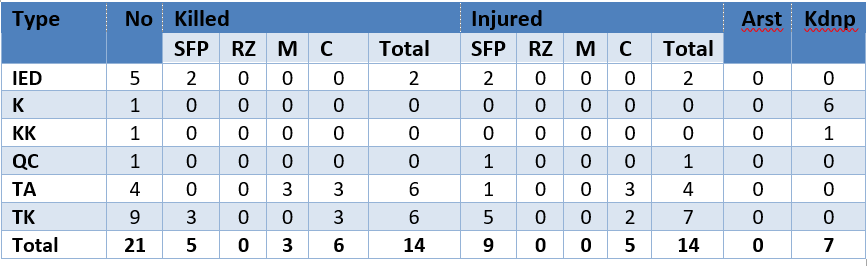
During 19–26 March 2026, militant violence in Pakistan showed a relative decline in lethality despite continued activity, with 21 attacks causing 14 deaths and 14 injuries—indicating a shift toward lower-intensity, more dispersed operations. The former FATA districts remained the epicentre, accounting for over half the attacks and the majority of casualties, while Khyber Pakhtunkhwa’s settled districts and Balochistan experienced comparatively lower-impact incidents. Tactically, militants relied more on targeted killings, limited-scale assaults, IEDs, and an increased use of kidnappings, alongside emerging tools such as quadcopters, reflecting adaptation and strategic recalibration. This pattern suggests deliberate restraint by militant groups, likely aimed at avoiding large-scale retaliatory responses while maintaining operational presence. Meanwhile, security forces intensified counterterrorism efforts, conducting 18 operations that resulted in 69 militant deaths, 24 injuries, and 22 arrests, indicating improved operational effectiveness and a broad, intelligence-led campaign across key conflict zones.
On 19 March, Chief of Army Staff Asim Munir warned against the spillover of foreign conflicts into Pakistan, stressing that violence triggered by external developments would not be tolerated, particularly in the wake of unrest following reports about Ali Khamenei. The protests on 1 March in Gilgit-Baltistan resulted in around 20 deaths and widespread damage, prompting a security crackdown and the formation of a high-level inquiry committee to investigate causes, response gaps, and accountability measures, while the army chief emphasized unity, restraint, and proactive diplomacy.
Pakistan’s leadership has moved toward greater strategic coordination amid economic strain and regional uncertainty, as a high-level meeting chaired by Asif Ali Zardari and attended by Prime Minister Shehbaz Sharif and other key officials underscored the need to align economic, energy, and security policies. Rising global oil prices and supply disruptions linked to Middle East tensions have intensified inflationary pressures, prompting a shift toward austerity, energy conservation, and tighter fiscal management, with discussions even hinting at possible smart lockdowns, reflecting a broader effort to manage prolonged external economic stress through coordinated governance.
Pakistan’s top ranking in the Global Terrorism Index 2026 highlights a sharp deterioration in its security environment, with 1,139 terrorism-related deaths and 1,045 incidents in 2025—the highest in over a decade. The resurgence of the banned Tehreek-i-Taliban Pakistan (TTP), responsible for over half of the fatalities, has been a key driver, aided by regional dynamics following the Afghan Taliban’s return to power. Violence remains concentrated in Khyber Pakhtunkhwa and Balochistan, while globally terrorism has declined, making Pakistan’s position more pronounced. A comparison with data from the Pakistan Institute for Conflict and Security Studies (PICSS) broadly confirms this deterioration, showing similar incident levels but higher fatalities and injuries.
Pakistan has emerged as an active diplomatic player in the Middle East crisis triggered on 28 February, engaging in coordinated outreach and backchannel efforts to de-escalate tensions between the US and Iran. On 20 March, PM Shehbaz Sharif held calls with multiple regional leaders to build consensus for dialogue, while by 23 March, Pakistan—alongside Turkiye and Egypt—helped facilitate a temporary pause in US strikes. Islamabad also conveyed a US-proposed 15-point framework to Tehran and offered to host talks, though Iran rejected key elements, showing persistent gaps. Despite an extended pause announced by Donald Trump, Pakistan’s role remains that of a facilitator amid deep mistrust and limited prospects for an immediate breakthrough.
Pakistan–Afghanistan relations remained tense despite a temporary Eid ceasefire from 18–19 March to 23–24 March following Operation Ghazab lil-Haq launched on 26 February. Pakistan maintained a firm stance against militant sanctuaries. Although no major escalation followed the ceasefire’s expiry, Pakistan’s firm response as well as mediatory efforts and pressure from interlacutors would have played a siginificant role reduction in violence from across the border and skirmishes on the border.
Pakistan–India tensions resurfaced through disputes over water and Kashmir, as Islamabad accused New Delhi at the UN of “weaponising water” by suspending the Indus Waters Treaty, a move dating back to April 2025. President Zardari called for its restoration, warning of threats to food security and livelihoods, while Pakistan also condemned the sentencing of Kashmiri leader Asiya Andrabi as politically motivated. The rivalry extended into the diplomatic arena, with S Jaishankar criticizing Pakistan’s mediation role in the Middle East, reflecting broader geopolitical competition amid shifting regional alignments.
Pakistan and China proceeded with the Sea Guardian naval exercise, as a Chinese naval vessel arrived on 25 March to participate in joint drills aimed at enhancing maritime cooperation and interoperability. The exercise, continuing until early April, includes both harbour and sea-phase activities and reflects the deepening strategic partnership between the two countries, signalling continuity in defence cooperation despite ongoing regional crises and reinforcing their shared commitment to maritime security and regional stability.