
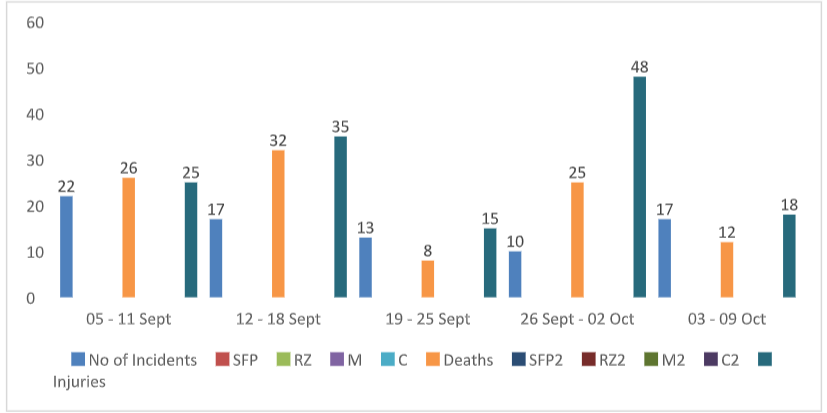
Militant activity in Pakistan surged during the week of October 3–9, with 17 attacks reported—marking a 70 percent increase from the previous week’s 10 incidents. Despite the rise in attacks, overall casualties declined, with 12 people killed and 18 injured compared to 25 deaths and 48 injuries earlier. The attacks were concentrated in Khyber Pakhtunkhwa (six incidents) and Balochistan (five), followed by two each in erstwhile FATA, Gilgit-Baltistan, and Sindh. The incidents included tactical assaults, kidnappings, IED blasts, targeted attacks, and a mortar strike. In response, security forces intensified operations, conducting eight intelligence- based operations that killed 42 militants and captured nine others, though 12 security personnel—including a lieutenant colonel and two majors—were also martyred, reflecting continued militant resistance. Major operations in Orakzai, Dera Ismail Khan, and Khuzdar resulted in the neutralization of key militant elements from TTP and BLA factions.
The week’s developments highlight a concerning rise in militant activity even as counterterrorism forces maintain operational pressure across multiple fronts. Imran Khan’s directive for PTI lawmakers to resign from Punjab Assembly committees and his decision to replace KP Chief Minister Ali Amin Gandapur with Sohail Afridi mark a renewed confrontational course with the establishment. Afridi, a hardliner from the tribal areas, has been tasked with aligning KP governance with Khan’s political vision, but his nomination risks political instability as securing a majority may prove difficult. The move has raised speculation about possible governor’s rule in KP, especially as federal authorities weigh counterterrorism priorities. Khan’s choices are seen as escalating confrontation over reconciliation, while the military’s recent statements against “political patronage of terror and crime” are seen as an indirect warning to PTI’s strategy. After several days of confrontation, the PML-N and PPP have begun de-escalating tensions following Prime Minister Shehbaz Sharif’s outreach to Bilawal Bhutto Zardari. Disputes over using the Benazir Income Support Programme (BISP) for flood relief in Punjab had triggered harsh exchanges and parliamentary walkouts by PPP lawmakers. The rift, which threatened the coalition’s Senate majority, now appears to be easing after meetings between President Zardari and senior government leaders. While the disagreement highlighted strains within the ruling alliance, analysts suggest it may have been partly managed to recalibrate political positions ahead of future elections.
The government’s crackdown on TLP ahead of its planned October 10 “Aqsa Million March” triggered violent clashes in Lahore and heightened security in Islamabad and Rawalpindi. Authorities imposed Section 144 across Punjab, sealed roads with containers, suspended transport, and detained hundreds of TLP activists to prevent the group’s march toward the US Embassy. The interior ministry accused TLP of inciting violence under the pretext of supporting Gaza, while mobile networks were suspended to curb unrest. The extensive security measures reflect fears of both violence and potential terror exploitation amid volatile public sentiment. Talks between Pakistan and the IMF ended without a staff-level agreement on two bailout programmes worth $8.4 billion, as differences persisted over fiscal discipline and flood- related expenditures.
The IMF sought verified damage assessments and provincial commitments to maintain cash surpluses. The World Bank also downgraded Pakistan’s growth forecast to 2.6 percent, citing flood damage and inflationary pressure. Meanwhile, multinational firms like Procter & Gamble joined an exodus of major investors, citing policy uncertainty and high costs. Despite reforms and the SIFC’s investment push, persistent structural weaknesses, instability, and weak governance continue to deter foreign capital. Pakistan and Malaysia reaffirmed their strategic partnership during Prime Minister Shehbaz Sharif’s visit to Kuala Lumpur, where six MoUs were signed covering defence, higher education, tourism, health, and anti-corruption cooperation. Both leaders vowed to reinvigorate ties under a pragmatic, ASEAN-centered approach to economic growth. Defence cooperation, air connectivity, healthcare, and cybersecurity were identified as priority areas, while expanded collaboration in trade and education aims to renew people-to-people links. The visit marked a significant step toward revitalizing bilateral relations after years of stagnation, positioning both countries for broader regional engagement. Indian and Pakistani tensions flared after synchronized warnings from India’s top defence leaders, including Defence Minister Rajnath Singh, who threatened a “decisive response” over the Sir Creek dispute.
The Indian Army and Air Force chiefs echoed this aggressive tone, claiming major military successes against Pakistan. Islamabad dismissed the statements as politically motivated rhetoric aimed at bolstering the BJP’s nationalist narrative before Bihar elections. Analysts see the coordinated remarks as a calculated political strategy to stir nationalism and distract from domestic challenges, raising concerns that a limited military escalation could be exploited for electoral gain. At the Moscow Format Consultations on Afghanistan, Pakistan renewed its call for joint regional action against terrorism emanating from Afghan soil. Special Representative Mohammad Sadiq emphasized the threat from TTP and other anti-Pakistan groups operating from Afghanistan.
The meeting, attended by Taliban representatives and regional powers, underscored collective concern over terrorism and urged Kabul to prevent its territory from being used against neighbors. Concurrently, Pakistan intensified counterterrorism operations, with Prime Minister Shehbaz Sharif and Defence Minister Khawaja Asif warning of cross-border strikes if threats persist. Unverified reports of airstrikes targeting TTP hideouts in Kabul and Khost added to speculation of covert regional escalation. US–Pakistan ties are undergoing cautious recalibration, with renewed engagement in defence, minerals, and maritime cooperation despite lingering sensitivities. Reports of a missile deal and a proposed US role in developing the Pasni port were denied by both sides, emphasizing transparency and sovereignty. Nonetheless, a $500 million US investment in Pakistan’s mineral sector marks growing economic collaboration. High-level visits, including that of Pakistan’s naval chief to Washington, signal revived strategic dialogue aimed at balancing autonomy with partnership, even as opposition voices in Pakistan warn against opaque dealings with Washington. Pakistan’s first top-level military delegation to Bangladesh since 1971 marked a symbolic breakthrough in bilateral ties. Led by Lt. Gen. Tabassum Habib, the delegation held talks in Dhaka from October 6–9, focusing on intelligence sharing, counterterrorism, and military training cooperation. The visit follows a series of high-level engagements in 2025 aimed at normalizing relations long marred by the legacy of the 1971 war. Occurring amid Bangladesh’s political transition, the visit drew regional attention, especially from India, which views closer Pakistan-Bangladesh ties as a potential shift in regional dynamics.