

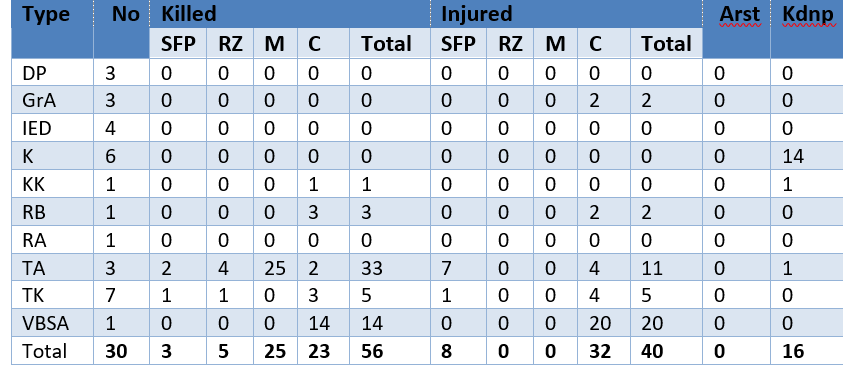
Militant violence declined in frequency during the reporting period (22–31 May 2026), with 30 attacks recorded nationwide compared to 48 during the previous week. However, the lethality of attacks increased significantly, resulting in 56 fatalities and 40 injuries, while at least 16 individuals were abducted. Balochistan remained the epicentre of violence, accounting for 24 attacks and experiencing militant activity across multiple districts targeting civilians, tribal figures, government-linked individuals and critical infrastructure. Although Khyber Pakhtunkhwa recorded relatively few attacks, it suffered the highest number of fatalities, reflecting a shift towards fewer but more lethal attacks, including high-intensity engagements and targeted attacks on peace committee members, tribal elders and political/religious figures. The merged districts also witnessed continued militant influence, highlighted by the killing of a prominent tribal elder opposed to militant activity. Targeted killings and kidnappings remained the most frequently employed militant tactics, while the suicide bombing targeting a passenger shuttle train near Quetta’s Chaman Phatak represented the deadliest incident of the reporting period. Claimed by the Baloch Liberation Army (BLA). Security forces maintained an active operational posture, conducting 11 counterterrorism actions that reportedly killed 38 militants.
Militant groups remained highly active in the information domain alongside operational activities. Several organisations, including Tehrik-i-Taliban Pakistan (TTP), Islamic State Khorasan Province (ISKP), Harkat-e-Inqilab-e-Islami Pakistan (HIIP), Jamaat-ul-Ahrar (JuA) and Ittehad-ul-Mujahideen Pakistan (IMP), used Eid ul Adha and Hajj-related messaging to reinforce ideological narratives, mobilise supporters and justify continued militancy. Baloch and jihadist groups claimed dozens of attacks across Balochistan and Khyber Pakhtunkhwa, while the reporting period also witnessed an intensification of the propaganda war between TTP and JuA, reflecting deepening divisions within the militant landscape. Reports of clashes between TTP and Tehrik-e-Taliban Ghazwat-ul-Hind (TTG) in North Waziristan suggested growing competition among militant factions.
At the domestic level, Prime Minister Shehbaz Sharif approved a four-year extension for Intelligence Bureau Director General Fuad Asadullah Khan, signalling the government’s preference for continuity within the civilian intelligence apparatus amid persistent security and political challenges. Political developments in Azad Jammu and Kashmir (AJK) and Gilgit-Baltistan (GB) highlighted governance and institutional challenges associated with upcoming elections. In AJK, disputes over refugee representation and reserved legislative seats continued to fuel political mobilisation, while in GB debates over electoral regulations, administrative neutrality and political participation intensified ahead of legislative elections.