
Militant Attacks in Pakistan: Declining Violence, Rising Kidnappings
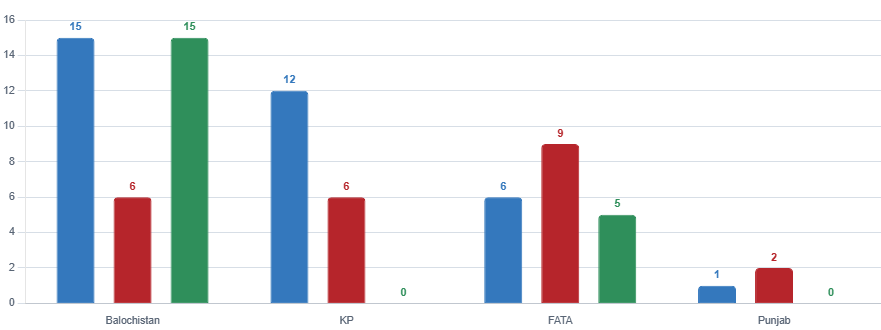
Militant attacks in Pakistan declined by 26.1 per cent during 9–15 October 2026, according to the PICSS Militancy Database, which recorded 34 attacks compared with 46 during the preceding week. However, this decline coincided with intensified political tensions and a series of propaganda initiatives by militant organisations seeking to influence public perceptions and demonstrate operational relevance. According to the PICSS Militancy Database, 34 militant attacks were recorded, down 26.1 per cent from the previous week. Fatalities declined by 45.2 per cent to 23, while injuries fell to 20. However, reported kidnappings increased from 14 to 24. Balochistan remained the most affected province, while attacks increased in Khyber Pakhtunkhwa despite the national decline.
TTP Exploits Political Developments and Promotes Organisational Survival
The Tehreek-e-Taliban Pakistan (TTP) sought to exploit the imposition of emergency and Governor’s Rule in Khyber Pakhtunkhwa, incorporating political grievances into its messaging against the state. More significantly, TTP chief Noor Wali Mehsud published a booklet examining why militant organisations survive or collapse, drawing selectively on research by the RAND Corporation. Meanwhile, the group circulated videos claiming operations in Kohat and temporary checkpoints in Balochistan’s Makran region, apparently seeking to demonstrate an operational presence beyond its traditional strongholds.
BLA Projects Maritime Capabilities and Targets Local Audiences
The Baloch Liberation Army (BLA) adopted a different propaganda approach, releasing footage of a claimed maritime attack near Jiwani and presenting its maritime wing as an expanding operational capability. Its accompanying communications combined disputed casualty claims, organisational commemorations and messaging directed towards Baloch personnel serving in provincial security institutions. Other Baloch militant groups also circulated operational videos and commemorative material intended to project continued activity and sustain organisational morale.
AQIS and IIP Pursue Ideological and Recruitment Narratives
Al-Qaeda in the Indian Subcontinent (AQIS) released another issue of Nawa-e-Ghazwa-e-Hind, combining ideological discourse, strategic writings and commentary on regional developments. Separately, Inqilab-e-Islami Pakistan (IIP) used the anniversary of the Muridke incident to promote its revolutionary narrative, raising questions about attempts to exploit grievances across traditional sectarian divisions.
What Do These Developments Indicate?
The latest PICSS Weekly Insight examines these propaganda activities alongside changing patterns of militant violence, provincial security trends, counterterrorism developments and Pakistan’s evolving political and regional security environment.
The complete PICSS Weekly Insight examines militant attacks in Pakistan alongside evolving propaganda strategies, counterterrorism responses and regional security developments.
Continue reading with PICSS
This content is available to Weekly Insight or Premium Research subscribers.