

Afghanistan, the heart of Asia, has its own dynamics of dealing with the outside world. Five years after the Taliban took over the country, serious questions are arising over whether the ruling Islamic Emirate will be able to integrate Afghanistan into the wider South Asian and Central Asian region, or whether the country will once again fall into chaos and instability amid concerns over the presence of militant groups on its soil and the continuing humanitarian crisis.
This predicament is further complicated by the diverging perspectives of its neighbours and other regional actors regarding the Taliban’s de facto leadership. Since the takeover, Pakistan, its eastern neighbour, has viewed Afghanistan largely through a security lens, accusing the Taliban of allowing militants to operate from Afghan soil, an allegation the Afghan Taliban denies. China and Russia, while similarly concerned about terrorism and regional security, have pursued pragmatic diplomatic and economic engagement with Kabul. Iran has expanded economic and transit cooperation despite withholding formal recognition, while India has steadily broadened humanitarian, economic and diplomatic engagement without formally recognizing the Taliban. Across Central Asia and the Middle East, growing emphasis on trade, connectivity and investment has likewise created new avenues of engagement. These differing approaches reflect a broader question: whether Afghanistan’s future can be shaped through confrontation, cautious engagement or deeper regional integration.
The Afghan Peace Dialogue
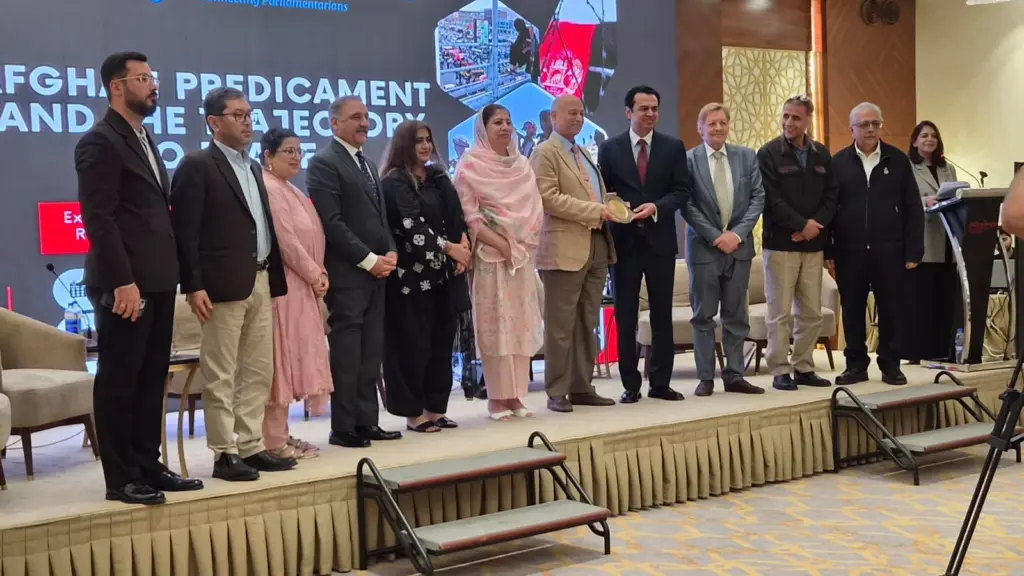
It was against the backdrop of these diverging perspectives that a two-day conference titled “Afghan Predicament and the Trajectory Towards Peace” was held in Islamabad on 29–30 September. It was organized by the International Parliamentarians’ Congress (IPC), a transcontinental parliamentary platform headquartered in Islamabad that brings together individual members of national parliaments to promote parliamentary cooperation and dialogue on global and regional issues. The stature of the conference was reflected in the calibre of those who participated, bringing together prominent diplomatic, political and strategic voices from across the region. Particularly significant was the presence of Albert P. Khorev, Ambassador of the Russian Federation to Pakistan, alongside prominent Russian voices such as Zamir Kabulov, who addressed the conference via video link, and Dr. Vladimir I. Sotnikov. From Pakistan, the conference brought together Senator Mushahid Hussain Sayed, Federal Minister for Information and Broadcasting Attaullah Tarar, and Ambassador Sadiq khan Pakistan’s special representative to Afghanistan, among other notable figures. The conference was planned and conducted under the supervison of Senator Sitara Ayaz, Secretary-General of the International Parliamentarians Congress (IPC). The participation of such high-level representatives underscored the conference’s broader diplomatic significance and its relevance as a platform for engaging key regional stakeholders in discussions on Afghanistan’s future and the prospects for peace. The participation of such high-level representatives underscored the conference’s broader diplomatic significance and its relevance as a platform for engaging the principal regional stakeholders in discussions on Afghanistan’s future and the prospects for peace.. Hence the conference provided a platform for different perspectives on Afghanistan’s political, security, humanitarian and socio-economic situation, and on its implications for regional peace, stability, connectivity and development. Its importance, therefore, lay not in resolving the Afghan predicament itself, but in bringing actors with different interests together around the same basic question: how can Afghanistan move towards lasting peace and stability while becoming more integrated with the wider region?
Pakistan Perspective
For Pakistan, the Afghan conundrum is mainly a question of security, governance and credible action. Pakistanviews Afghanistan’s narrow and exclusionary governance, weak institutions and restrictions on women as factors that undermine stability and create space for militancy. From Pakistan’s perspective, Ambassador Sadiq khan who serves as the Pakistan’s special representative to Afghanistan emphasized that Afghanistan needs peace with itself before having peace with the world. Its main concern, however, remains the presence of militant organizations on Afghan soil and the threat they pose beyond Afghanistan’s borders, he further added. He stressed that Pakistan has repeatedly pursued dialogue and peaceful coexistence but increasingly stresses the need for verifiable action rather than assurances from Kabul.
Federal Minister Attaullah Tarar of Pakistan, while speaking at the conference, warned that Pakistan’s desire for peace should not be mistaken for weakness and argued that violent extremism and militancy remained major obstacles to peaceful coexistence and regional connectivity. He also stressed that Pakistan had repeatedly pursued negotiations and dialogue with Kabul. Referring to the prospects for peace, he stated: “Peace can be achieved, yes. Was peace given a chance, yes. But is there a will to achieve peace? The answer, unfortunately, is no.”
Pakistan’s position therefore contains a clear tension: it wants peaceful coexistence and continued engagement, but increasingly sees meaningful engagement as dependent on concrete and verifiable action from Kabul. In the context of the deteriorating security relationship, Pakistan has also indicated that it will continue to take measures it considers necessary to protect its territory and citizens from cross-border threats. Thus, Islamabad’s approach combines diplomatic engagement with coercive pressure, reflecting its view that security concerns must be addressed before broader regional cooperation can fully develop. These tensions also manifested in direct military action, On 1 October, Pakistan carried out airstrikes in Afghanistan’s Kunar and Helmand provinces claiming to have killed 22 militants. Taliban government and United Nations Assisting Mission in Afghanistan that at least 10 civilians, mostly children, were killed and nine injured, Pakistan rejected these claims saying its strikes were precise, proportionate and well calibrated against the militant locations.
Yet Pakistan’s security-centered approach is not the only perspective presented at the conference. The participation of former Afghan officials brought into the discussion a different understanding of the internal political roots of Afghanistan’s predicament.
The Afghan Perspective
The two-day conference also brought Mohammad Tahir Zuhair, a former Afghan minister of information and culture, and Amanullah Paiman, a former member of the Afghan parliament, who attended the conference as representatives of the former Afghan political establishment. Amanullah Paiman accused the Taliban of creating conditions that had made life difficult for a large section of Afghanistan’s population.
Paiman alleged that the Taliban had excluded significant segments of Afghan society from political participation. He also accused the group of undermining Afghanistan’s cultural and historical identity, including the Persian/Darri language. He further attributed responsibility to the Taliban for the political and military environment that preceded the killing of former president Mohammad Najibullah. Paiman also argued that the Taliban posed a major security challenge to Pakistan amid deteriorating relations between Kabul and Islamabad.
Together, their remarks reflected the perspective of Afghanistan’s former republican political establishment, which sees the Taliban’s exclusionary rule as a central obstacle to a sustainable political settlement and regional stability. Their intervention also highlighted an important dimension of the Afghan conundrum that goes beyond cross-border security: whether lasting stability can be achieved without a political framework that accommodates Afghanistan’s diverse social and political groups.
This emphasis on internal political inclusion provides an important point of comparison with Russia’s approach. While the former Afghan representatives focused heavily on the legitimacy and inclusiveness of the political order, Moscow has increasingly emphasized engagement with the authorities in Kabul as a means of promoting stability and preventing Afghanistan from becoming a source of wider regional insecurity.
Russian Perspective
Russia approached the Afghan question mainly through regional stability, diplomatic engagement and economic self-sufficiency. Ambassador Zamir Kabulov addressed the conference via video link, stating that that Russia wants Afghanistan to become a “peaceful country that lives in harmony with all its neighbors,” while also stressing the importance of helping Afghans achieve greater economic self-sufficiency.
Kabulov further emphasized the importance of regional engagement with Afghanistan, stressing the need for a peaceful Afghanistan that lives in harmony with its neighbours. Moscow has also supported regional diplomatic mechanisms, including the Moscow Format, as platforms for dialogue and engagement rather than further isolation. The subsequent eighth Moscow Format consultations, however, also demonstrated the limits of regional consensus. Russia’s approach is therefore based strongly on engagement with Kabul, with economic development and regional cooperation viewed as important components of long-term stability.
This position is also distinct because Russia is currently the only country to have formally recognized the Taliban-led government. Consequently, Moscow’s approach illustrates how engagement with Kabul can coexist with concerns over terrorism and regional security, while placing greater emphasis on maintaining communication and integrating Afghanistan into regional economic and diplomatic processes.
Tajikistan
The Tajik perspective brought yet another dimension to the discussion, particularly because of Afghanistan’s direct proximity to Central Asia. At the conference, Tajikistan’s position focused on the security risks emanating from Afghanistan, particularly the presence of militant groups and the potential spillover of instability into neighbouring states.
Tajik representatives also argued that lasting peace would require greater political inclusion, raising concerns over the exclusion of sections of Afghan society from governance. They stressed the importance of a political settlement that reflects Afghanistan’s ethnic diversity rather than relying solely on security measures. Tajikistan’s representatives further linked Afghanistan’s stability to economic development, trade and stronger regional connectivity. One Tajik representative, Bakhtiyor Ahmadzoda, emphasized that Afghanistan’s peace, stability and sustainable development are directly linked to the security and prosperity of neighbouring countries, while arguing that lasting peace cannot be achieved through security measures alone.
The Tajik position therefore illustrates the dual nature of the Afghan challenge for Central Asian states: Afghanistan is simultaneously viewed as a potential security risk and as an important component of future regional connectivity and economic cooperation. This duality also provides a point of convergence between the otherwise differing approaches expressed at the Islamabad conference.
Islamabad Declaration
Despite these differences, the discussions revealed areas of convergence. The Islamabad Declaration 2026, adopted at the conclusion of the conference, attempted to translate the concerns raised during the discussions into a broader set of priorities and recommendations. The declaration identified political inclusion, women’s rights, counterterrorism, regional stability and economic development as important areas requiring attention. The issue of women’s rights also gained renewed international attention when the International Criminal Court unsealed arrest warrants on 5 October against four senior Taliban officials over alleged crimes against humanity involving gender persecution.. The development further illustrates the gap between the Taliban’s efforts to expand external diplomatic engagement and the continuing international scrutiny of its domestic policies. The IPC confirmed that the declaration set out observations and recommendations emerging from the two days of deliberations.
The declaration argued that Afghanistan’s internal crisis has consequences for neighbouring states and called for a collective approach to engagement with Kabul based on clear benchmarks. It recommended restoring education, employment and healthcare opportunities for women and girls; expanding modern, scientific and vocational education; preventing terrorist safe havens, recruitment and financing; and improving transparency in international aid delivery.
At the regional level, the declaration proposed a joint SCO–UN–OIC monitoring mechanism and called for engagement with Kabul to be linked to measurable conditions and accountability. It also emphasized that counterterrorism commitments, political inclusion and citizens’ rights should form part of the framework through which future international engagement with Afghanistan is assessed.
The declaration ultimately presented an inclusive and representative political order as a prerequisite, in the conference’s assessment, for lasting peace within Afghanistan and the wider region. Its central message was that the “first frontier of peace is internal.”
Subsequent regional developments also illustrate the difficulty of translating this convergence into a common regional position. The eighth Moscow Format consultations on Afghanistan, held in Moscow on 5 October, ended without a joint statement after the Afghan and Pakistani delegations disagreed over the wording of the final document. Russia’s Special Presidential Representative for Afghanistan, Zamir Kabulov, said the disagreement centred on references to Afghanistan in the context of terrorism and acknowledged that the participants had been unable to agree on the final text.
The development is significant in the context of the perspectives discussed at the Islamabad conference. While the Moscow Format remains a platform for regional dialogue and cooperation, the failure to adopt a joint statement highlights the continuing difficulty of reconciling Afghanistan’s security concerns with those of its neighbours, particularly Pakistan. It therefore suggests that regional engagement is expanding, but a common approach to Afghanistan remains difficult to achieve.
Conclusion
Five years after the Taliban takeover, Afghanistan’s central dilemma is whether internal stability can be achieved without deeper political inclusion and credible security commitments.
The differing approaches of Pakistan, Russia, Tajikistan and other regional actors suggest that engagement alone cannot resolve Afghanistan’s problems, while isolation may further limit prospects for regional integration. The Islamabad conference highlighted the need to reconcile Afghanistan’s internal political challenges with the security and economic interests of its neighbours, while subsequent regional diplomacy has demonstrated how difficult such reconciliation remains. The Islamabad Declaration reflects this linkage by placing internal peace, counterterrorism, political inclusion and regional cooperation within the same framework, but the absence of consensus at the subsequent Moscow Format meeting underscores the gap between identifying common priorities and agreeing on how they should be addressed
Afghanistan’s trajectory will therefore depend on whether Kabul can turn its strategic geography into a basis for regional connectivity rather than allowing unresolved internal and security challenges to reinforce regional instability.