
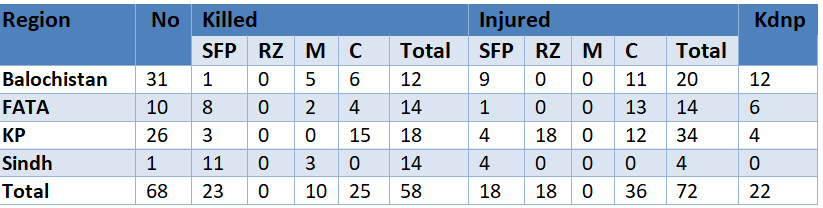
The reporting period (19 June–2 July) witnessed a marked deterioration in Pakistan’s security environment, characterized by a sharp rise in militant violence, greater tactical sophistication, and an expanding geographical footprint. A total of 68 militant attacks claimed 58 lives and injured 72 others, with civilians accounting for the largest share of fatalities, while security forces also sustained significant losses, particularly in the high-profile suicide assault on the Pakistan Rangers headquarters in Karachi. Militants employed a diverse range of tactics—including tactical assaults, suicide bombings, IEDs, quadcopter strikes, targeted killings, and attacks on critical infrastructure—demonstrating both operational adaptability and the capacity to strike security installations and civilian targets across multiple regions simultaneously. Although security forces maintained sustained counterterrorism pressure by eliminating 46 militants in 18 intelligence-based operations and disrupting several planned attacks, the escalation in militant violence, the increasing use of emerging technologies such as quadcopters, and the successful execution of complex attacks against heavily protected targets underscore the continued resilience and operational capability of militant organizations. The Karachi attack, in particular, suggests that groups such as Jamaat-ul-Ahrar retain both the intent and capability to expand their operations beyond traditional conflict zones into major urban centres, posing a growing challenge to Pakistan’s internal security.
Economic activity in Muzaffarabad partially resumed after traders and transporters ended a weeks-long shutdown following government assurances on security and fuel supplies. However, the recovery remained constrained by internet disruptions, banking limitations, and fuel shortages. Politically, the protest movement weakened as traders and transporters publicly distanced themselves from the proscribed Joint Awami Action Committee (JAAC), arguing that it had shifted from socio-economic demands to a broader political agenda. Meanwhile, authorities arrested JAAC leader Shaukat Nawaz Mir, continued to restrict opposition support for the movement by preventing leaders of the Tehreek-i-Tahafuz Ayeen-i-Pakistan from travelling to Rawalakot, while protests persisted in parts of Poonch division. Pakistan and Saudi Arabia expanded their strategic partnership through new agreements on security cooperation and sports development. During Interior Minister Mohsin Naqvi’s visit to Riyadh, both countries signed a memorandum of understanding to enhance bilateral security cooperation, while the Pakistan Cricket Board and the Saudi Arabian Cricket Federation agreed to jointly develop an international-standard cricket stadium in Jeddah as part of Saudi Arabia’s Vision 2030. The visit also highlighted growing institutional cooperation, with Pakistani officials receiving briefings on Saudi Arabia’s integrated security management system.