

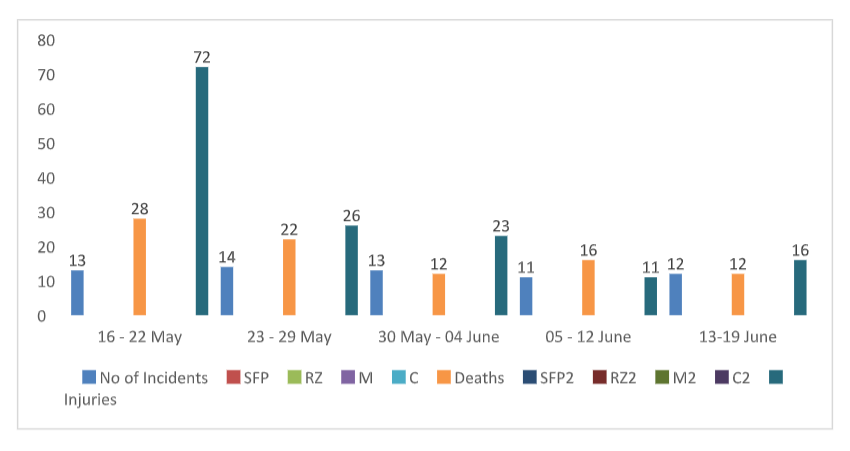
During the past week, Pakistan witnessed 12 militant attacks resulting in 12 fatalities —
including nine security personnel and three civilians — and injuries to 16 others. The attacks
were concentrated in erstwhile FATA, Balochistan, and mainland KP, involving tactics like IEDs,
rocket fire, targeted killings, and direct assaults. Security forces responded with four major
operations, killing seven militants and arresting 40. Notably, the Tehreek-e-Taliban Pakistan
(TTP) appeared to shift focus northward, with increased activity in Chitral and propaganda
suggesting renewed efforts in Punjab’s Gujrat district. These developments point to a possible
geographic expansion of militant activity and highlight the need for sustained counterterrorism
vigilance.
Pakistan’s Chief of Army Staff, Field Marshal Syed Asim Munir’s five-day visit to the
United States marked a notable strategic recalibration in Pakistan-US relations, taking place
amid heightened regional tensions, particularly following Israeli airstrikes on Iran. In a rare
diplomatic move, Munir was hosted by US President Donald Trump at the White House without
civilian accompaniment, where wide-ranging discussions reportedly covered counterterrorism,
trade, emerging technologies, and regional security. Trump lauded Munir’s role in averting a
potential nuclear conflict with India, while US CENTCOM Chief Gen. Kurilla praised Pakistan’s
cooperation in operations against IS-K, including the capture of a key suspect in the Abbey Gate
bombing. Though the visit signaled growing US appreciation for Pakistan’s counterterrorism
role, analysts noted the persistent strategic imbalance due to Washington’s tilt toward India.
Nonetheless, Munir’s engagements, including outreach to the Pakistani-American community,
emphasized Pakistan’s commitment to regional peace, economic innovation, and diplomatic
relevance—particularly in the context of Kashmir, where tensions remain high and international
concerns over South Asia’s stability persist.
PTI founder Imran Khan postponed planned nationwide protests, citing the Iran-Israel
conflict and the need for national unity. While protests were held by PTI supporters in
Washington during Field Marshal Asim Munir’s visit, the meeting between Munir and US
President Donald Trump was perceived as a diplomatic win by the government but criticized by
PTI activists who had hoped Trump would back Khan’s release. Simultaneously, the Supreme
Court issued a split verdict upholding the government’s authority to transfer judges across high
courts under Article 200 — a move that alters seniority in the Islamabad High Court and
weakens the influence of judges perceived to favor PTI. The party, facing the pending Rs190
million corruption case against Khan, plans to challenge the ruling. Meanwhile, Defence
Minister Khawaja Asif lauded the Munir-Trump meeting as a foreign policy success driven by
Pakistan’s “hybrid governance model,” though analysts caution it further entrenches military
dominance at the expense of civilian authority — a dynamic the ruling PML-N appears to accept
in return for its limited administrative hold.
Amid rising Middle East tensions following Israeli strikes on Iran, Pakistan has firmly
aligned itself with Tehran, condemning the attacks as violations of international law and urging
a multilateral diplomatic effort to prevent regional escalation. Prime Minister Shehbaz Sharif
reaffirmed support for Iran in a call with President Masoud Pezeshkian, who welcomed
Pakistan’s solidarity and called for greater Islamic unity. While Pakistan has temporarily closed
several border crossings with Iran due to security concerns, it continues limited trade through
Taftan and has facilitated the return of 3,000 citizens from Iran. The Foreign Office dismissed
any plans for military involvement or refugee relocation, reiterating that Pakistan’s relationship
with the US remains cooperative but non-interventionist in this crisis. While Islamabad supports
de-escalation, its pro-Iran stance could face serious challenges if the conflict prolongs or draws
in direct US involvement. Backchannel messaging during the Trump-Munir meeting may have
subtly conveyed Pakistan’s efforts to balance ties with both Washington and Tehran, all while
ensuring stability in its immediate neighbourhood and avoiding any move that might contribute
to regime change in Iran.
International engagement with Taliban-led Afghanistan is undergoing a notable
recalibration amid regional volatility, with countries gradually opening diplomatic channels and
pursuing strategic interests despite the group’s lack of formal recognition. Norway became the
first European state to accept a Taliban-appointed diplomat, signaling growing diplomatic
normalization. Concurrently, an EU-led meeting in Brussels involving the G7, UN, and Afghan
civil society stressed the importance of sustained aid tied to human rights and inclusivity
benchmarks. In Central Asia, regional powers are taking a more active role: Uzbekistan
proposed a high-level group on Afghanistan with Taliban participation, endorsed by China and
Kyrgyzstan, while Russia deepened ties by accepting the Taliban’s ambassador and praising
Kabul’s counterterrorism cooperation. Kazakhstan appointed a special representative for
Afghanistan. On the economic front, Iran-Afghanistan trade disruptions due to the Iran-Israel
conflict have spiked fuel prices in Herat, although trade via Central Asian routes continues.
Afghanistan supports Iran’s right to self-defense but aims to remain neutral. Meanwhile,
Pakistan is positioning Gwadar Port as an alternate trade corridor, easing transit requirements
and courting Afghan cooperation in regional stability and development. In a significant
economic shift, the Taliban cancelled its major oil contract with Chinese firm Afchin over non-
compliance, signalling both assertiveness and potential friction in Afghanistan-China relations,
even as Kabul seeks new foreign investment under its own terms.