
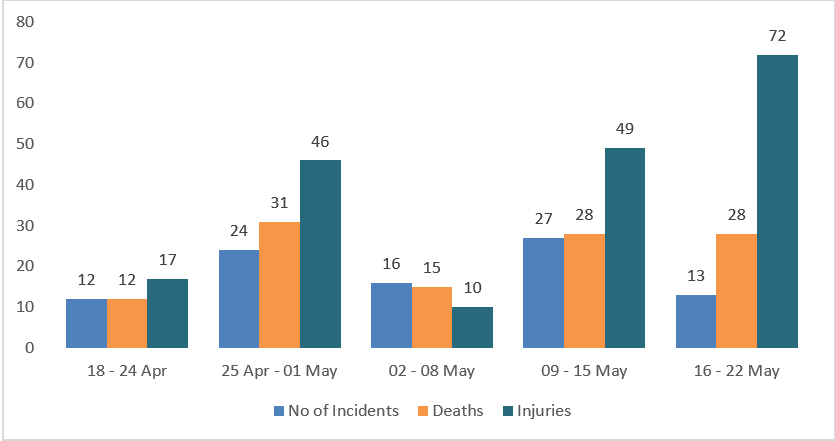
During the week of 16–22 May 2025, militant activity across Pakistan declined sharply in frequency, with 13 attacks marking a 52% drop from the previous week, though operational intensity and lethality remained high, with 28 killed and 72 injured. Balochistan witnessed the most violence, including a deadly suicide attack on an APS bus in Khuzdar, killing four students and injuring dozens. Additional attacks in the province targeted CPEC routes and security personnel, while counter-terror operations killed multiple militants. Khyber Pakhtunkhwa saw three incidents, including a TTP assault on a police post and subsequent security operations eliminating seven militants. In erstwhile FATA, a drone strike killed four children, and clashes claimed lives on both sides. Sindh experienced a targeted killing in Badin and security raids in Karachi, capturing TTP and BLA-linked suspects. Despite the reduced number of incidents, the scale and coordination of attacks highlight the persistent threat posed by militant networks.
Pakistan has entered critical budget negotiations with the IMF, aiming to solidify a new fiscal plan and secure ongoing financial support under the Extended Fund Facility. While recent macroeconomic indicators—such as a current account surplus, easing inflation, and lower interest rates—reflect improved economic fundamentals, the country remains burdened by deep structural challenges including a $20 billion external financing gap and weak agricultural output. The proposed Rs17.5 trillion federal budget includes an 18% hike in defense spending amid rising India tensions, while still adhering to IMF stabilization targets with modest public sector pay increases. However, the ambitious Rs14.3 trillion tax collection goal has drawn criticism amid a sluggish industrial recovery, prompting the government to consider income tax relief for salaried individuals. The outcome of coalition-level consensus-building and IMF alignment will be pivotal to sustaining Pakistan’s fragile recovery.
Speculation of reconciliation between PTI and the military arose after both sides made unusually conciliatory remarks during a period of heightened national security concerns. However, hopes for rapprochement quickly faded as sharp internal divisions re-emerged within PTI over the symbolic elevation of COAS General Asim Munir to Field Marshal. While party chairman Gohar Ali Khan welcomed the move, Imran Khan, speaking from jail, lambasted it as emblematic of unchecked military power, reiterating his refusal to negotiate with the civilian government. Khan condemned the crackdown on PTI leaders after the May 9 protests and criticized what he called selective justice. This internal rift reflects the party’s broader strategic confusion, swinging between confrontation and reluctant outreach, further complicating its political positioning.
A drone strike in North Waziristan’s Mir Ali tehsil killed four children and injured five civilians, triggering mass protests and accusations of indiscriminate targeting. While locals initially suspected the military’s involvement, the ISPR denied this and blamed the banned TTP factions, labeling them as “Fitna Al Khwarij” and framing the attack as part of a misinformation campaign to discredit counterterrorism efforts. The incident reignited longstanding concerns over drone use in civilian areas, with the Human Rights Commission of Pakistan and political leaders like Maulana Fazlur Rehman demanding an independent investigation and a strategic rethink. The episode has deepened public mistrust in official narratives and highlighted the ongoing civilian toll of Pakistan’s counterterrorism strategies in tribal regions.
A deadly bomb attack on a school bus in Khuzdar, Balochistan, killed six people including children and injured over 40, prompting Pakistan to accuse India of orchestrating the attack through state-sponsored proxies. The government, military, and top leadership swiftly condemned the bombing and asserted it as part of India’s broader campaign to destabilize Pakistan, particularly in Balochistan and Khyber Pakhtunkhwa. Authorities cited intelligence implicating Indian involvement, including alleged links to National Security Adviser Ajit Doval. The military’s 270th Corps Commander Conference reinforced this narrative, pledging decisive action against foreign-backed terrorism. The incident underscores escalating cross-border tensions and a shift toward targeting civilian infrastructure, particularly educational institutions, in Pakistan’s conflict landscape.
While Pakistan and India have reportedly agreed to revert their armed forces to peacetime positions along the Line of Control by May 30, signalling and posturing persist amid a fragile de-escalation process. The agreement, coordinated by DGMOs with U.S. diplomatic facilitation, follows recent skirmishes that both sides now claim as victories. Pakistan elevated Army Chief Gen. Asim Munir to Field Marshal and extended the Air Chief’s tenure to project strength, while India maintains an aggressive posture through Prime Minister Modi’s military visits and continued assertions of its “new normal.” Despite backchannel communications and military-level coordination, New Delhi is reluctant to enter formal talks, fearing domestic backlash. Internally, the Modi government faces mounting criticism from opposition parties over the handling of the crisis and President Trump’s repeated claims of brokering peace. While Islamabad remains cautious of potential Indian adventurism, particularly amid Modi’s domestic political troubles, it is also preparing for dialogue — possibly mediated by third parties — while India prefers informal backchannels over official negotiations.
In a significant diplomatic development, the foreign ministers of Afghanistan, Pakistan, and China met in Beijing on May 21, 2025, to reaffirm commitments to regional peace, economic integration, and counterterrorism cooperation. The three countries agreed to enhance trust and connectivity, with China and Pakistan supporting the extension of CPEC into Afghanistan. Pakistan committed to elevating its diplomatic presence in Kabul, reflecting a shift from a security-centric to a more engagement-oriented policy — reportedly influenced by Chinese advice. The trilateral meeting, the first since 2023, follows a series of diplomatic visits, indicating increasing convergence among the three countries. Meanwhile, India has also signaled its intent to reengage diplomatically with the Taliban regime, potentially intensifying regional competition over influence in Afghanistan. The timing and conduct of the next trilateral meeting will be a key indicator of whether these evolving ties lead toward formal recognition of the Taliban regime.
The recent India-Pakistan conflict has prompted deeper strategic alignment between China and Pakistan, with Beijing publicly backing Pakistan’s security and territorial integrity. China’s unprecedented military and diplomatic support during the crisis, including possible intervention threats, signaled its concern over Indian adventurism and instability in the region. Post-conflict, Pakistani Foreign Minister Ishaq Dar’s visit to Beijing facilitated bilateral and trilateral meetings, underlining shared concerns over regional security and militant threats, particularly in KP and Baluchistan. Unconfirmed reports suggest China may soon deliver J-35A stealth jets to Pakistan, potentially reshaping South Asia’s airpower dynamics and showcasing Chinese military capabilities to potential buyers. While such enhanced cooperation serves mutual interests, it also raises the risk of increased attacks on Chinese interests in Pakistan by hostile actors, possibly with Indian backing, seeking to disrupt this deepening alliance.
Afghanistan is increasingly engaging the international community through a series of diplomatic and economic overtures, particularly with regional powers such as Russia, China, and Pakistan. A milestone was reached on May 16 when the Taliban nominated an ambassador to Moscow, signaling formal diplomatic normalization. These developments reflect Afghanistan’s intent to integrate into regional economic and political frameworks despite lacking formal recognition from many countries. The Taliban leadership has sought broader partnerships under the Belt and Road Initiative, supported by China and Pakistan, while also participating in multilateral forums like the China-Pakistan-Afghanistan trilateral dialogue. Concurrently, India appears to be re-evaluating its stance, cautiously initiating contact with Afghan officials. This expanding network of engagements indicates a shifting regional alignment toward gradual normalization of the Taliban-led government through economic cooperation and pragmatic diplomacy.During the week of 16–22 May 2025, militant activity across Pakistan declined sharply in frequency, with 13 attacks marking a 52% drop from the previous week, though operational intensity and lethality remained high, with 28 killed and 72 injured. Balochistan witnessed the most violence, including a deadly suicide attack on an APS bus in Khuzdar, killing four students and injuring dozens. Additional attacks in the province targeted CPEC routes and security personnel, while counter-terror operations killed multiple militants. Khyber Pakhtunkhwa saw three incidents, including a TTP assault on a police post and subsequent security operations eliminating seven militants. In erstwhile FATA, a drone strike killed four children, and clashes claimed lives on both sides. Sindh experienced a targeted killing in Badin and security raids in Karachi, capturing TTP and BLA-linked suspects. Despite the reduced number of incidents, the scale and coordination of attacks highlight the persistent threat posed by militant networks.
Pakistan has entered critical budget negotiations with the IMF, aiming to solidify a new fiscal plan and secure ongoing financial support under the Extended Fund Facility. While recent macroeconomic indicators—such as a current account surplus, easing inflation, and lower interest rates—reflect improved economic fundamentals, the country remains burdened by deep structural challenges including a $20 billion external financing gap and weak agricultural output. The proposed Rs17.5 trillion federal budget includes an 18% hike in defense spending amid rising India tensions, while still adhering to IMF stabilization targets with modest public sector pay increases. However, the ambitious Rs14.3 trillion tax collection goal has drawn criticism amid a sluggish industrial recovery, prompting the government to consider income tax relief for salaried individuals. The outcome of coalition-level consensus-building and IMF alignment will be pivotal to sustaining Pakistan’s fragile recovery.
Speculation of reconciliation between PTI and the military arose after both sides made unusually conciliatory remarks during a period of heightened national security concerns. However, hopes for rapprochement quickly faded as sharp internal divisions re-emerged within PTI over the symbolic elevation of COAS General Asim Munir to Field Marshal. While party chairman Gohar Ali Khan welcomed the move, Imran Khan, speaking from jail, lambasted it as emblematic of unchecked military power, reiterating his refusal to negotiate with the civilian government. Khan condemned the crackdown on PTI leaders after the May 9 protests and criticized what he called selective justice. This internal rift reflects the party’s broader strategic confusion, swinging between confrontation and reluctant outreach, further complicating its political positioning.
A drone strike in North Waziristan’s Mir Ali tehsil killed four children and injured five civilians, triggering mass protests and accusations of indiscriminate targeting. While locals initially suspected the military’s involvement, the ISPR denied this and blamed the banned TTP factions, labeling them as “Fitna Al Khwarij” and framing the attack as part of a misinformation campaign to discredit counterterrorism efforts. The incident reignited longstanding concerns over drone use in civilian areas, with the Human Rights Commission of Pakistan and political leaders like Maulana Fazlur Rehman demanding an independent investigation and a strategic rethink. The episode has deepened public mistrust in official narratives and highlighted the ongoing civilian toll of Pakistan’s counterterrorism strategies in tribal regions.
A deadly bomb attack on a school bus in Khuzdar, Balochistan, killed six people including children and injured over 40, prompting Pakistan to accuse India of orchestrating the attack through state-sponsored proxies. The government, military, and top leadership swiftly condemned the bombing and asserted it as part of India’s broader campaign to destabilize Pakistan, particularly in Balochistan and Khyber Pakhtunkhwa. Authorities cited intelligence implicating Indian involvement, including alleged links to National Security Adviser Ajit Doval. The military’s 270th Corps Commander Conference reinforced this narrative, pledging decisive action against foreign-backed terrorism. The incident underscores escalating cross-border tensions and a shift toward targeting civilian infrastructure, particularly educational institutions, in Pakistan’s conflict landscape.
While Pakistan and India have reportedly agreed to revert their armed forces to peacetime positions along the Line of Control by May 30, signalling and posturing persist amid a fragile de-escalation process. The agreement, coordinated by DGMOs with U.S. diplomatic facilitation, follows recent skirmishes that both sides now claim as victories. Pakistan elevated Army Chief Gen. Asim Munir to Field Marshal and extended the Air Chief’s tenure to project strength, while India maintains an aggressive posture through Prime Minister Modi’s military visits and continued assertions of its “new normal.” Despite backchannel communications and military-level coordination, New Delhi is reluctant to enter formal talks, fearing domestic backlash. Internally, the Modi government faces mounting criticism from opposition parties over the handling of the crisis and President Trump’s repeated claims of brokering peace. While Islamabad remains cautious of potential Indian adventurism, particularly amid Modi’s domestic political troubles, it is also preparing for dialogue — possibly mediated by third parties — while India prefers informal backchannels over official negotiations.
In a significant diplomatic development, the foreign ministers of Afghanistan, Pakistan, and China met in Beijing on May 21, 2025, to reaffirm commitments to regional peace, economic integration, and counterterrorism cooperation. The three countries agreed to enhance trust and connectivity, with China and Pakistan supporting the extension of CPEC into Afghanistan. Pakistan committed to elevating its diplomatic presence in Kabul, reflecting a shift from a security-centric to a more engagement-oriented policy — reportedly influenced by Chinese advice. The trilateral meeting, the first since 2023, follows a series of diplomatic visits, indicating increasing convergence among the three countries. Meanwhile, India has also signaled its intent to reengage diplomatically with the Taliban regime, potentially intensifying regional competition over influence in Afghanistan. The timing and conduct of the next trilateral meeting will be a key indicator of whether these evolving ties lead toward formal recognition of the Taliban regime.
The recent India-Pakistan conflict has prompted deeper strategic alignment between China and Pakistan, with Beijing publicly backing Pakistan’s security and territorial integrity. China’s unprecedented military and diplomatic support during the crisis, including possible intervention threats, signaled its concern over Indian adventurism and instability in the region. Post-conflict, Pakistani Foreign Minister Ishaq Dar’s visit to Beijing facilitated bilateral and trilateral meetings, underlining shared concerns over regional security and militant threats, particularly in KP and Baluchistan. Unconfirmed reports suggest China may soon deliver J-35A stealth jets to Pakistan, potentially reshaping South Asia’s airpower dynamics and showcasing Chinese military capabilities to potential buyers. While such enhanced cooperation serves mutual interests, it also raises the risk of increased attacks on Chinese interests in Pakistan by hostile actors, possibly with Indian backing, seeking to disrupt this deepening alliance.
Afghanistan is increasingly engaging the international community through a series of diplomatic and economic overtures, particularly with regional powers such as Russia, China, and Pakistan. A milestone was reached on May 16 when the Taliban nominated an ambassador to Moscow, signaling formal diplomatic normalization. These developments reflect Afghanistan’s intent to integrate into regional economic and political frameworks despite lacking formal recognition from many countries. The Taliban leadership has sought broader partnerships under the Belt and Road Initiative, supported by China and Pakistan, while also participating in multilateral forums like the China-Pakistan-Afghanistan trilateral dialogue. Concurrently, India appears to be re-evaluating its stance, cautiously initiating contact with Afghan officials. This expanding network of engagements indicates a shifting regional alignment toward gradual normalization of the Taliban-led government through economic cooperation and pragmatic diplomacy.