

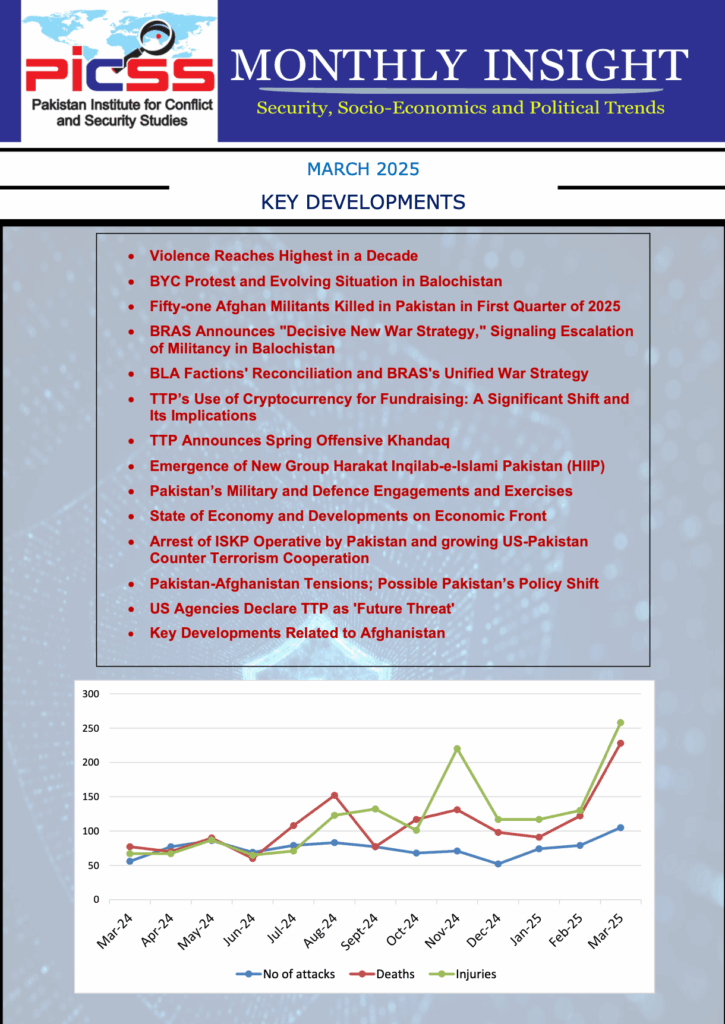
The security situation in Pakistan worsened significantly in March 2025, witnessing the deadliest month in a decade with 105 militant attacks—the highest since November 2014. These attacks claimed 228 lives, including 73 security personnel, 67 civilians, and 88 militants, while injuring 258 others. Six suicide attacks, mostly in Balochistan and Khyber Pakhtunkhwa (KP), caused 59 deaths and 94 injuries. Balochistan was especially affected by high-profile incidents such as the BLA’s hijacking of the Jaffar Express and three suicide bombings, resulting in 122 fatalities and 148 injuries. KP recorded 206 deaths, particularly in the tribal districts and southern KP, while Punjab witnessed a notable increase in TTP-linked attacks, especially in Dera Ghazi Khan. Sindh saw low-intensity incidents, while Islamabad, AJK, and Gilgit-Baltistan remained relatively quiet, although a TTP operative was arrested in AJK.
Security forces responded with 31 major operations across the country, resulting in 107 deaths—83 of them militants—and arresting 31 suspected militants. Most operations were concentrated in KP and erstwhile FATA, while Punjab saw a wave of arrests centered in Lahore. The deteriorating situation led to a high-level Parliamentary Committee on National Security (PCNS) meeting on March 19, attended by civil and military leadership. The meeting emphasized full implementation of counterterrorism measures such as the National Action Plan and Operation Azm-i-Istehkam, as well as enhanced powers for security agencies. The military reportedly requested three months and expanded legal authority to tackle militancy, while officials hinted at cross-border actions in Afghanistan. Despite PTI’s boycott of the meeting, discussions pointed to a hardened national stance against militancy and Afghan refugees, though KP’s PTI-led government expressed reservations over the refugee repatriation policy.
In March 2025, Baloch insurgency witnessed a major escalation as the Baloch Raji Aajoi Sangar (BRAS), comprising groups like the BLA, BLF, BRG, and SLO, announced a unified “Baloch National Army” and a decisive shift toward coordinated, large-scale, tech-driven guerrilla warfare targeting Pakistani and Chinese interests, especially CPEC. BRAS aims to internationalize the conflict through diplomatic outreach and media campaigns, while emphasizing ideological training and unity among militant factions. This development was underscored by the reconciliation of rival BLA factions, enabling more sophisticated joint operations such as the Kalat suicide bombing. Simultaneously, the BLF launched an English- language magazine, Sarmachar, to promote its separatist agenda to global audiences and gain legitimacy by framing its struggle as a fight against colonial oppression. These shifts pose serious security, economic, and diplomatic challenges for Pakistan.
The Tehrik-i-Taliban Pakistan (TTP) has recently intensified its ideological, operational, and financial campaigns against the Pakistani state. It released a video showing the arrest of two alleged ISI agents, issuing threats to civilians and Punjab police while warning against collaboration with state institutions. Simultaneously, TTP unveiled a new General Code of Conduct that expands its list of legitimate targets to include political parties, judges, government lawyers, and tribal peace committees, marking a departure from its prior restraint towards non-combatants. The group also announced its Spring Offensive, “Operation Khandaq,” vowing to deploy suicide bombers and modern weaponry—much of it possibly acquired from post-NATO Afghanistan—across various regions, especially KP and Balochistan. In a major shift in financing, TTP publicly appealed for donations via cryptocurrency, using QR codes linked to wallets on platforms like Binance and TRON, which presents significant challenges to Pakistan’s counter-terrorism financing efforts. A video statement by TTP chief Mufti Noor Wali Mehsud further sharpened the group’s narrative by targeting the military and intelligence services directly, accusing them of systemic anti-Islamic actions and manipulation of democratic processes. Collectively, these developments reflect a renewed and more sophisticated insurgency aimed at destabilizing Pakistan through ideological warfare, expanded militant operations, and globalized financial networks.
Pakistan’s defense partnerships in March 2025 strengthened through joint military exercises, including the Arabian Monsoon VI with Russia and the KOMODO-25 with Indonesia. Additionally, Pakistan expanded defense ties with South Africa and Bahrain. These effortsunderscore Pakistan’s growing role in regional and global defense cooperation.
On economic front, Pakistan has shown sign of economy recovery though challenges still persist. Pakistan may key policy to reduce tariffs in line with IMF guidelines to stimulate trade, and electricity tariffs were lowered to ease pressures on citizens. Revenue losses from tariff cuts remain concerns, compounded by a 29% tariff on textiles imposed by the US.
In counterterrorism, Pakistan’s arrest of ISKP operative Sharifullah and his subsequent handover to the US marked a diplomatic win. This action was linked to the Kabul Airport attack, raising questions about ISKP’s internal dynamics. Despite the complexity of the situation, this move strengthened US-Pakistan ties, though narratives about the attack’s mastermind remain unclear. US intelligence agencies, in March 2025, identified the Tehreek- e-Taliban Pakistan (TTP) as a future threat to the US, highlighting its historical ties to al-Qaeda. The report underscored concerns over TTP’s potential global ambitions. Meanwhile, ISIS- Khorasan was also designated as a major global threat due to its continued targeting ofregions like South and Central Asia.
In Afghanistan, political developments included Abdul Rab Rasul Sayyaf’s proposal for an Islamic consultative council, challenging the Taliban’s authority. The Taliban’s internal reforms aimed to bolster control amid declining security, worsening economic conditions, and a growing humanitarian crisis. The UN extended its mission to address these issues, and the US sent a delegation to Kabul, signaling a thaw in US-Taliban relations.
To download complete report with fully charts and graphs please subscribe or login if you are a subscriber.