
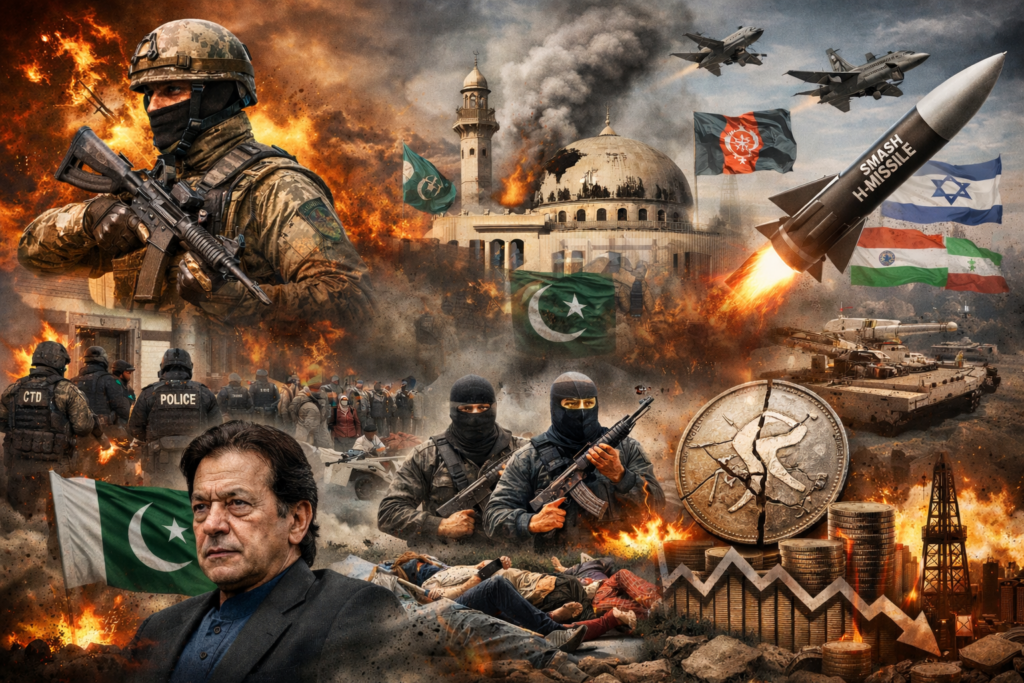
Pakistan’s security, political, and economic environment during February 2026
remained complex and volatile. Militant violence continued at elevated levels across several
regions, while counter-terrorism operations intensified in response to evolving threats. At the
same time, domestic political developments, regional security dynamics, and fragile economic
conditions shaped the country’s strategic outlook.
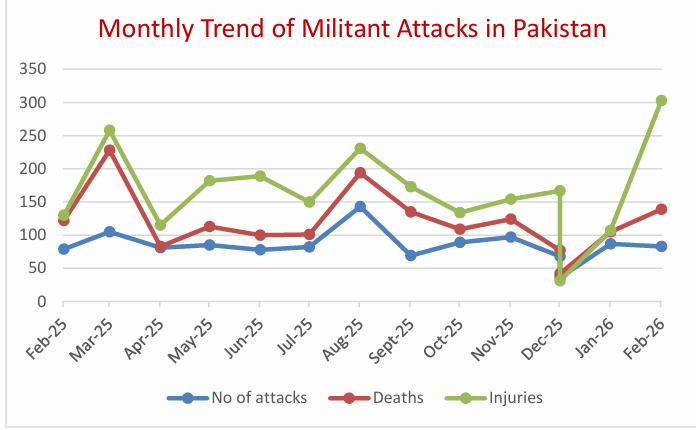
Militant violence remained a major concern during the month. A total of 83 militant
attacks were recorded nationwide, resulting in 139 fatalities and 303 injuries. Although the
number of attacks declined slightly compared to January, their lethality increased
significantly. Fatalities rose by about 32 percent, while injuries surged sharply—largely due to
a high-casualty suicide bombing in Islamabad that killed 35 people and injured 169 others.
Khyber Pakhtunkhwa and the tribal districts remained the primary theatres of militant
activity, recording the highest number of incidents and casualties, while Balochistan
continued to witness sporadic attacks linked to Baloch militant groups. The pattern of
violence indicates that militant networks retain operational capabilities across multiple
regions, combining sustained attacks in traditional conflict zones with occasional high-impact
strikes in urban centres to generate psychological and political effects.
Pakistan’s counter-terrorism operations remained robust during the month. Security
forces conducted 40 notable operations in February—slightly fewer than in January—but
these operations proved more lethal. A total of 278 militants were killed, representing a
significant increase compared to the previous month. However, the operational environment
also proved more costly for both security forces and civilians. Security forces suffered 31
fatalities, more than double the losses recorded in January, while civilian deaths also
increased. Balochistan remained the principal theatre of operations as authorities continued
efforts to dismantle insurgent networks following major attacks by the Baloch Liberation
Army in Late January. Khyber Pakhtunkhwa and the tribal districts also witnessed intensified
operations targeting militants.
A major security development during the month was the suicide bombing at the
Khadija al-Kubra Mosque in Islamabad on 6 February. The attack exposed security
vulnerabilities in the federal capital and highlighted the growing sophistication of Islamic
State–linked networks operating in Pakistan. Investigations revealed that the attack was part
of a broader operational network linked to Islamic State–Khorasan Province (ISKP), involving
cross-regional facilitation networks and technological tools such as encrypted
communications and digital financial channels. The discovery of cross-border linkages and the
involvement of women in logistical roles illustrated the evolving tactics of militant groups.
Analysts increasingly view ISKP as a growing threat alongside the Tehreek-e-Taliban Pakistan
(TTP), particularly due to its ability to conduct high-casualty attacks.
Institutional developments during the month indicated ongoing efforts to strengthen
Pakistan’s counter-terrorism framework. The Counter-Terrorism Department formally began
operations in Gilgit-Baltistan with the establishment of a dedicated CTD police station in Gilgit
responsible for handling terrorism-related cases across the region. The initiative aims to
strengthen law enforcement capacity and improve security along the strategically important
Karakoram Highway, though financial constraints remain a challenge.
Political dynamics during the month were strongly influenced by concerns over the
health of former prime minister Imran Khan. Reports of deteriorating eyesight and alleged
delays in medical treatment triggered strong reactions from the opposition and intensified
political tensions. The Supreme Court intervened by ordering a medical examination and
facilitating family contact, while protests by Pakistan Tehreek-e-Insaf supporters disrupted
transport routes in parts of Khyber Pakhtunkhwa. Although tensions eased following court
intervention, the issue became a central factor shaping government–opposition relations.
Meanwhile, coordination between the federal government and the Khyber
Pakhtunkhwa administration showed tentative improvement amid rising security challenges.
Engagement between federal and provincial leadership focused on strengthening counter
terrorism coordination, addressing financial issues, and implementing development
initiatives in conflict-affected districts. Authorities also discussed plans for the gradual
transfer of law-and-order responsibilities from the military to civilian institutions in areas
where security conditions have improved.
Pakistan also continued efforts to strengthen its conventional military capabilities. The
Pakistan Air Force conducted its major exercise “Golden Eagle,” which demonstrated
advancements in artificial intelligence-enabled and multi-domain warfare capabilities,
including integration of manned and unmanned platforms. At the same time, Pakistan
unveiled the SMASH hypersonic anti-ship ballistic missile, reflecting continued investment in
advanced defence technologies aimed at maintaining conventional deterrence.
Regionally, Pakistan faced growing security challenges linked to developments in
Afghanistan. International concern over terrorism emanating from Afghan territory
increased, with the United Nations and China warning that militant groups—particularly the
Tehreek-e-Taliban Pakistan—pose a growing threat to regional stability. Tensions between
Pakistan and Afghanistan escalated after a deadly militant attack in Bajaur and Pakistan’s
subsequent airstrikes on alleged militant hideouts in eastern Afghanistan. The crisis
intensified further when Pakistan launched Operation Ghazab lil-Haq in response to cross
border hostilities. While regional actors such as Türkiye and China have shown interest in
facilitating dialogue, mistrust between Islamabad and Kabul remains significant.
Pakistan also expressed concern about the expanding strategic partnership between
India and Israel, viewing growing defence cooperation between the two countries as a
potential challenge to regional stability.
Islamabad reassured China that the security of Chinese nationals and projects remains
a national priority, particularly in Balochistan where attacks targeting infrastructure projects
have increased.
Beyond security concerns, Pakistan continued to pursue active diplomacy aimed at
strengthening economic and strategic partnerships. During February, Pakistan expanded
engagement with several countries—including Jordan, Azerbaijan, Libya, Kazakhstan,
Uzbekistan, Austria, Qatar, and Indonesia—through agreements covering trade, defence
cooperation, investment, and regional connectivity. Pakistan also launched the Quadrilateral
for Migration dialogue with Italy, Spain, and Greece to improve migration management and
expand legal employment opportunities for Pakistani workers in Europe.
Pakistan’s economic outlook nevertheless remains fragile despite signs of
macroeconomic stabilisation. Poverty has risen to around 29 percent—affecting nearly 70
million people—while inequality and unemployment have also increased significantly.
Although the government continues engagement with the International Monetary Fund to
secure financial support, the country remains heavily dependent on external financing and
creditor rollovers. At the same time, escalating tensions in the Middle East—particularly the
conflict involving Iran, Israel, and the United States—pose potential risks for Pakistan’s
energy-dependent economy, as disruptions to global oil supplies could intensify inflationary
pressures and complicate economic stabilisation efforts. These hostilities will have
implications for Pakistan security environment in coming days.