
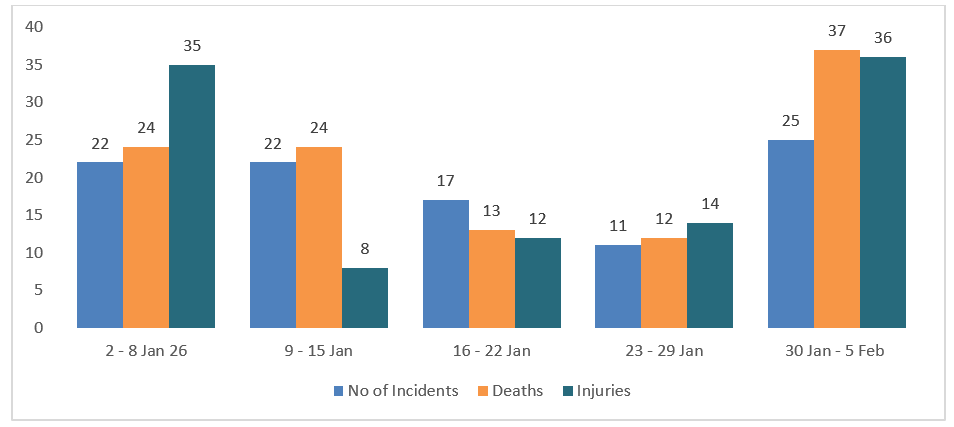
During the week under review, Pakistan witnessed a sharp escalation in militant violence, with 25 attacks nationwide causing 37 fatalities and 36 injuries, largely concentrated in Balochistan, where 14 attacks resulted in 26 deaths and 29 injuries, reflecting a coordinated and high-impact campaign dominated by suicide attacks, targeted killings, and assaults on security infrastructure; KP and erstwhile FATA also remained volatile, while Punjab saw limited spillover. Tactical assaults and targeted killings remained prevalent, but suicide attacks proved the deadliest. In response, security forces mounted an unprecedented counterterrorism surge, conducting 24 operations nationwide and reportedly killing 363 militants and arresting 13 suspects, with Balochistan accounting for the overwhelming majority of these actions—an operational tempo and militant attrition rate unmatched in Pakistan’s two-and-a-half decades of counterterrorism.
On 31 January 2026, Balochistan witnessed one of the most intense and coordinated waves of militant violence in recent years, as the banned Baloch Liberation Army (BLA) launched near-simultaneous attacks across multiple districts, targeting police stations, security installations, prisons, government offices, banks, transport infrastructure, and civilian areas using suicide bombings, vehicle-borne IEDs, armed assaults, arson, robberies, and hostage-taking. Termed by the group as “Operation Herof 2.0,” the offensive was presented by the BLA as a multi-day, province-wide campaign involving its elite units and suicide cadres, with expansive—but unverified—claims of territorial penetration and inflated casualty figures. Pakistani authorities accused India of sponsoring and directing the attacks, and reported heavy civilian losses alongside a large-scale counterterrorism response that killed dozens of militants. The violence triggered sweeping security measures, including province-wide Section 144, suspension of rail and internet services, and sustained clearance operations, while provoking strong political, diplomatic, and international reactions and culminating in the conclusion of Operation Radd-ul-Fitna-1, which the military said killed 216 militants but at the cost of significant civilian and security force casualties.
On 5 February, Pakistan observed Kashmir Solidarity Day, reaffirming national support for the Kashmiri people’s right to self-determination through rallies, seminars, symbolic human chains, and nationwide tributes. The country’s political and military leadership reiterated diplomatic, moral, and political backing for Kashmir, urged international intervention to halt alleged human rights violations, and renewed calls for the implementation of UN Security Council resolutions through a plebiscite, framing the Kashmir issue as central to regional peace and stability.
Recent days also saw tentative signs of a political thaw, with quiet backchannel signals between the government and opposition and a visible reset in Centre–KP relations amid rising militancy. Gestures such as medical facilitation for Imran Khan, limited family meetings, and high-level Centre–province engagement on security and finances suggested an effort to reduce political temperature ahead of planned protests, while KP’s apex committee publicly aligned with the federal government on counterterrorism coordination. Whether these openings translate into sustained cooperation will hinge on implementation, protest dynamics, and the possibility of broader national-level security consultations.
The Peshawar High Court upheld the federal government’s ban on the Pashtun Tahafuz Movement (PTM) and the proscription of its leadership under the Anti-Terrorism Act, dismissing petitions that challenged the legality and constitutionality of the move. While the court issued a short order with detailed reasoning pending, the ruling keeps the ban in force, reinforcing the government’s position and leaving unresolved broader questions about due process, political expression, and the legal thresholds for proscription.
International concern over terror spillover from Afghanistan intensified as China and the United Nations warned that militant groups operating from Afghan soil—particularly the TTP—are destabilising the region. Pakistan echoed these concerns at the UN, accusing the Afghan Taliban of failing to curb anti-Pakistan militants and warning that unchecked cross-border terrorism risks wider regional destabilisation, a view increasingly shared by global observers amid rising violence since 2021.
On the economic front, Pakistan and Jordan agreed to move toward a preferential trade agreement and expand cooperation across 16 sectors during the 10th Joint Ministerial Commission session, signalling a shift toward more results-driven engagement. The two sides committed to structured follow-up mechanisms, revived business platforms, and new working groups, aiming to translate political goodwill into tangible trade, investment, and technology outcomes.
Regionally, Pakistan signalled a constructive diplomatic role as it prepared to participate in renewed US–Iran talks, reflecting its behind-the-scenes engagement to defuse rising tensions in the Gulf. With military incidents raising fears of escalation, Pakistan’s inclusion alongside key regional states underscored its growing relevance as a mediator, even as the prospects for a durable breakthrough between Washington and Tehran remain uncertain.
Pakistan also reinforced its defence diplomacy, reaffirming naval cooperation with Azerbaijan, deepening a strategic defence partnership with Libya through implementation of a major arms and training agreement, and renewing its strategic military relationship with Türkiye, with discussions reportedly extending to potential trilateral defence cooperation involving Saudi Arabia. These engagements reflect Islamabad’s broader effort to diversify defence partnerships and expand its defence export footprint.
In Central Asia, Pakistan elevated ties with Kazakhstan to a strategic partnership, setting a $1 billion trade target and signing a wide-ranging package of agreements spanning connectivity, energy, defence, and technology, while positioning its ports as gateways for Central Asian trade. Similarly, Pakistan and Uzbekistan agreed to boost bilateral trade to $2 billion within five years, launching a strategic cooperation council and prioritising regional connectivity projects, particularly rail links through Afghanistan, as pillars of long-term integration. Pakistan reaffirmed that the security of Chinese nationals and projects remains a top priority, with the interior minister assuring Beijing of enhanced protection measures follofollowing the January 31 attacks in Balochistan. The engagement reflected both China’s concern over growing threats and Pakistan’s effort to reinforce confidence in its counterterrorism posture, even as the security environment in Balochistan continues to test bilateral assurances.