
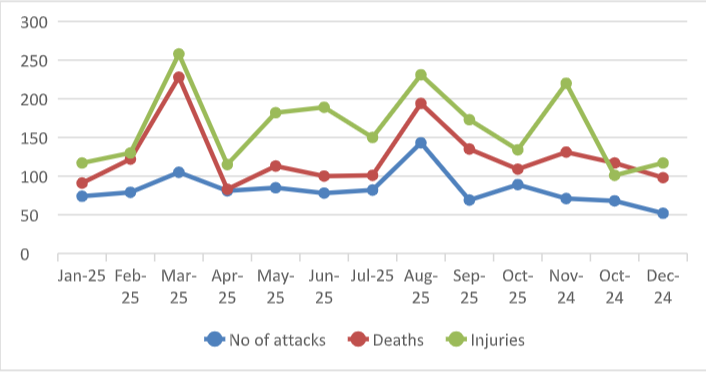
Militant violence in Pakistan rose sharply in October, reversing the relative calm
observed in September. A total of 89 attacks were reported nationwide—29 percent higher
than the previous month—resulting in 109 deaths and 134 injuries. Security personnel
remained the primary targets, accounting for most casualties. Khyber Pakhtunkhwa
(mainland and tribal districts) and Balochistan together made-up 92 percent of all incidents,
reaffirming their position as the epicenters of militancy. Mainland KP witnessed 37 incidents
and 48 fatalities, while the tribal districts saw 22 attacks and 31 deaths, including several
abductions. Balochistan recorded 23 attacks causing 27 deaths and 36 injuries, with a surge
in kidnappings. Violence in Sindh, Punjab, and Gilgit-Baltistan remained low.
Security forces maintained an aggressive operational tempo, conducting 51 major
counterterrorism operations across the country. These actions resulted in the killing of at
least 331 militants—the highest monthly toll in a decade—reflecting a decisive escalation in
Pakistan’s counter-militancy campaign. Seventeen security personnel and one civilian also
lost their lives, while 27 others were injured. The tribal districts remained the main theatre,
where 22 operations eliminated 209 militants and 16 security personnel. Balochistan saw 11
operations killing 67 militants, and 15 in mainland KP eliminated 55 militants. Smaller
actions in Punjab, Sindh, and GB led to arrests with minimal casualties. These developments
highlight the intensity and precision of Pakistan’s intelligence-led strategy focused on pre-
emptive and leadership-targeted operations. The killing of Qari Amjad, the TTP’s shadow
defence minister and senior leader, in a targeted Bajaur operation marked one of the
group’s biggest setbacks since its resurgence. The strike, enabled by precise intelligence,
exposed Pakistan’s deep infiltration into the TTP and underscored its shift toward
leadership-focused counterterrorism.
The federal and Punjab governments launched a sweeping crackdown on Tehreek-e-
Labbaik Pakistan (TLP) after its planned “Aqsa Million March” and violent clashes. Over
2,700 activists, including top leaders, were arrested under the Anti-Terrorism Act, with
assets seized and key figures placed on the Fourth Schedule. The operation, aimed at
preserving public order and averting sectarian unrest, received rare support from several
Barelvi scholars. The government’s firm but measured approach prevented major agitation,
though TLP’s ideological influence is likely to persist. If sustained, this could mark a turning
point in curbing street-level religious extremism.
Politically, Pakistan Tehreek-e-Insaf (PTI) intensified its confrontational stance,
heightening civil–military and centre–province tensions. Imran Khan’s decision to withdraw
PTI legislators from parliamentary committees and replace KP Chief Minister Ali Amin
Gandapur with loyalist Sohail Afridi underscored deliberate defiance of state institutions.
Afridi’s criticism of counterterrorism operations as “war crimes” strained relations with the
military, prompting warnings from army leadership against politicizing militancy. The
standoff risks undermining policy coherence and coordination at a time of heightened
militant activity.
Pakistan’s economy showed cautious stabilization amid structural challenges. The
World Bank revised growth projections downward to 2.6 percent for FY2025/26, citing
flood-related losses, inflation, and weak investor confidence. Nonetheless, Pakistan
achieved modest fiscal discipline and a current account surplus under IMF-supported
reforms. The IMF’s October review acknowledged progress but called for continued energy,
tax, and trade reforms. Government efforts to restructure tariffs and advance climate
adaptation are positive steps, but political instability and regional tensions—especially with
Afghanistan—remain key risks to sustained recovery.
Pakistan-Afghanistan relations entered one of their most volatile phases following
Pakistani airstrikes in Kabul and other provinces, which prompted Taliban retaliation and
intense border clashes before an uncertain ceasefire was brokered through Qatari and
Turkish mediation. Islamabad’s actions reflected frustration over Kabul’s inaction against
the TTP and signaled a shift from diplomacy to coercion. At the Moscow Format
Consultations, Pakistan reiterated calls for regional counterterrorism cooperation, but
mutual accusations persisted. Disputes such as the proposed India-backed Kunar River dam
and hostile media narratives deepened mistrust. While the Istanbul understanding
temporarily eased tensions, lasting stability depends on verifiable Taliban action against
anti-Pakistan elements.
Tensions with India escalated after inflammatory statements by senior Indian
officials, including Defence Minister Rajnath Singh’s warning of a “resounding response” to
any Pakistani move in Sir Creek. Indian military leaders reinforced an aggressive tone,
though analysts viewed the rhetoric as election-driven, aimed at stirring nationalist
sentiment. Pakistan responded firmly, vowing swift retaliation to any provocation, though
the confrontation so far proved rhetorical rather than a precursor to conflict.
Pakistan’s foreign and defence diplomacy gained notable momentum in October,
reflecting a broader strategy to strengthen regional partnerships and diversify strategic
engagements. Relations with Bangladesh entered a new phase of rapprochement through
the first high-level military exchanges since 1971, focusing on intelligence sharing,
counterterrorism, and training cooperation—signaling mutual efforts to move beyond
historical grievances and quietly unsettling India. In the Middle East, Army Chief Gen. Asim
Munir’s visits to Egypt, Jordan, and Saudi Arabia, along with Interior Minister Mohsin
Naqvi’s engagements in Iran and Oman, underscored Pakistan’s bid to deepen defence,
intelligence, and economic cooperation while aligning with regional stability efforts,
including discussions on a proposed Gaza stabilization mission. Prime Minister Shehbaz
Sharif’s visit to Malaysia further revitalized bilateral ties through six MoUs spanning
defence, education, health, aviation, tourism, and anti-corruption, emphasizing economic
pragmatism and stronger engagement under the ASEAN framework. Meanwhile, Pakistan’s
joint counterterrorism exercise Dostarym-V with Kazakhstan in Cherat enhanced tactical
interoperability and reaffirmed Islamabad’s commitment to regional security collaboration.
Meanwhile, Afghanistan accelerated its diplomatic outreach amid strained ties with
Pakistan. Kabul engaged the United States, India, China, the EU, and Gulf states to seek
legitimacy and reintegration. The U.S. informally mediated border de-escalation; India
upgraded its Kabul mission to a full embassy; and the Taliban pursued trade and
infrastructure linkages through Iran, Turkey, and Central Asia. These moves reflect a
pragmatic effort to balance isolation with broader economic and diplomatic engagement
despite persistent security frictions.