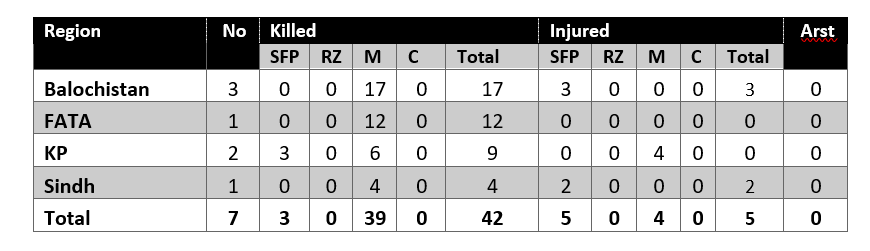
Pakistan’s counter-terrorism (CT) architecture has undergone a significant transformation since late 2022. Under the leadership of Field Marshal General Syed Asim Munir, the state has moved away from intermittent negotiations with armed groups and toward a force-centric, intelligence-led, and institutionally coordinated security model. This shift marks one of the most consequential recalibrations in Pakistan’s internal security doctrine since the post-2014 National Action Plan (NAP) era.
A Strategic Break from the Past
The transition reflects a clear departure from the final phase of General Qamar Javed Bajwa’s tenure, during which dialogue with the Tehrik-i-Taliban Pakistan (TTP) was explored through Afghan mediation. The 2022 ceasefire ultimately collapsed, with attacks resuming and militant demands clashing with Pakistan’s constitutional framework. The failure of that process hardened institutional thinking within the security establishment.
Under General Munir, negotiations with anti-state armed groups have been categorically ruled out. Militancy is now framed as a persistent, adaptive threat requiring sustained disruption rather than political accommodation. The revived doctrine prioritizes intelligence-based operations, tighter border management, and willingness to impose cross-border costs where threats are perceived to originate.
Under General Munir, negotiations with anti-state armed groups have been categorically ruled out. Militancy is now framed as a persistent, adaptive threat requiring sustained disruption rather than political accommodation. The revived doctrine prioritizes intelligence-based operations, tighter border management, and willingness to impose cross-border costs where threats are perceived to originate.
Beyond Borders: A Transnational Security Lens
A defining feature of the current CT model is its expansion beyond Pakistan’s territorial boundaries. The security establishment increasingly views internal militancy as inseparable from cross-border sanctuaries, particularly in Afghanistan.
This perspective has driven three major policy streams:
Large-scale repatriation of undocumented Afghan nationals under the “Illegal Foreigners Repatriation Plan.”
Sustained diplomatic pressure on the Afghan Taliban to act against TTP elements.
Cross-border air and drone strikes targeting militant infrastructure inside Afghanistan.
While these measures have reportedly disrupted militant logistics and degraded operational capabilities, they have also strained Pakistan–Afghanistan relations and drawn international scrutiny, especially over humanitarian implications.
Institutional Reconfiguration: Repairing the Coordination Deficit
Perhaps the most enduring changes are institutional rather than kinetic.
Pakistan has sought to address long-standing coordination failures between civilian and military actors by reactivating and strengthening core mechanisms:
Revival of Apex Committees
High-level federal and provincial Apex Committees—overseeing implementation of the National Action Plan—have become more active and structured. These bodies bring together the Prime Minister, Army Chief, intelligence heads, provincial leadership, and law enforcement officials to align threat assessments and operational responses.
Re-empowering NACTA
The National Counter Terrorism Authority (NACTA), long criticized for institutional weakness, has regained centrality. It now serves as a national coordination hub for intelligence-sharing and policy harmonization, though it remains advisory rather than operational in nature.
A major milestone has been the creation of the National Intelligence Fusion and Threat Assessment Center (NIFTAC), linking federal, provincial, and district-level intelligence platforms (PIFTACs and DIFTACs). This layered system is designed to reduce fragmentation and enable real-time threat analysis across agencies.
Legal and Policy Tightening
To reinforce operational changes, Pakistan has amended the Anti-Terrorism Act and introduced provincial legislative updates. These include:
Restoration of preventive detention provisions allowing temporary detention of suspects without formal charges.
Expanded tools to counter terrorism financing and online radicalization.
New provincial amendments, particularly in Balochistan and Punjab, strengthening investigative and prosecutorial mechanisms.
While these legal tools enhance state capacity, they have also sparked debate over civil liberties and due process protections.
Parallel to hard measures, NACTA has advanced soft-prevention frameworks, including the National Prevention of Violent Extremism (NPVE) Policy. This approach integrates education reform, community engagement, youth outreach, and deradicalization programs into the broader security architecture.
The Role of Paramilitary Forces
Paramilitary forces remain central to Pakistan’s CT posture, particularly in high-risk regions.
The Frontier Corps continues to play a leading role in border security, counter-militancy operations, and protection of strategic installations in Khyber Pakhtunkhwa and Balochistan. The 2025 restructuring of the Frontier Constabulary—renamed the Federal Constabulary—expanded its jurisdiction nationwide, reinforcing internal security layering.
These forces operate with military oversight but are increasingly integrated into coordinated intelligence and legal frameworks.
Securing Strategic Assets: The CPEC Dimension
Counter-terrorism policy has also expanded into economic security, particularly protection of China-Pakistan Economic Corridor (CPEC) assets.
Pakistan maintains two dedicated army formations for CPEC security:
The 34th Light Infantry Division (SSD North), headquartered in Chilas.
The 44th Light Infantry Division (SSD South), headquartered in Gwadar.
These divisions combine army and paramilitary components to safeguard routes, infrastructure, and Chinese personnel. Provincial police units and special protection wings complement the effort.
In January 2026, Pakistan announced the creation of a Special Protection Unit (SPU) dedicated exclusively to safeguarding Chinese nationals and projects, reflecting heightened security sensitivities and bilateral coordination.
Tactical Gains, Strategic Ambiguity
Official figures suggest intensified operations have neutralized thousands of militants over the past year. Intelligence-sharing has improved, threat anticipation appears more structured, and rapid response capacity has expanded.
Yet the broader environment remains volatile. Pakistan ranked among the most terrorism-affected countries in recent global assessments, with fatalities rising in 2025. Militant groups have adapted through decentralization, cross-border mobility, and high-impact urban attacks.
The current model has undoubtedly strengthened institutional coherence and signaled strategic resolve. However, structural improvements alone may not guarantee long-term stability. Militancy persists not only because of safe havens and ideology, but also due to governance gaps, regional geopolitical tensions, and localized grievances.
The Road Ahead
Pakistan’s evolving CT structure under General Asim Munir represents a decisive shift toward centralized coordination, persistent pressure, and integrated security governance. The system is more synchronized than in previous cycles and less tolerant of political experimentation with armed actors.
The critical question, however, is whether institutional consolidation will be matched by parallel improvements in rule of law, provincial governance capacity, and political stability. Without that balance, Pakistan risks remaining locked in a high-intensity management cycle—containing militancy rather than conclusively shrinking its operating space.
For policymakers and observers alike, the durability of this model will depend not only on force projection and intelligence fusion, but on whether strategic coherence can translate into sustainable security outcomes.