

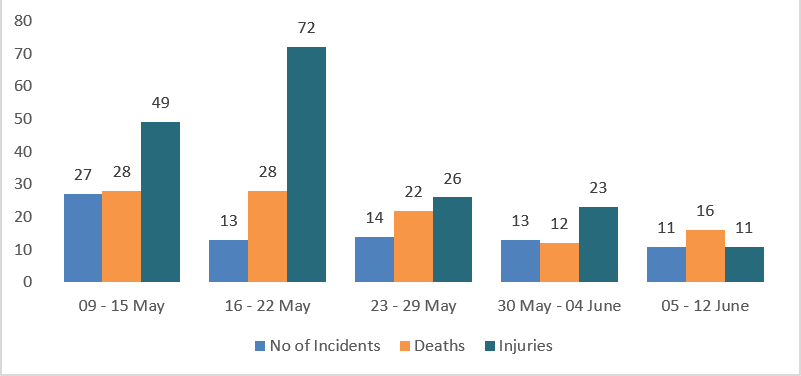
During the eight-day period from 5 to 12 June 2025, which included Eid-ul-Azha, militant activity saw a slight decline in frequency but remained intense in impact. Eleven attacks were reported—down from 13 in the previous six-day period—yet resulted in increased fatalities, rising from 12 to 16, including five security personnel, while injuries dropped from 23 to 11. The attacks were concentrated in erstwhile FATA (4), Balochistan (3), KP (3), and Sindh (1), comprising four targeted killings, three IED blasts, three tactical assaults, and one mortar attack. Despite the holiday, security forces maintained high alert and conducted a targeted operation that killed two suspected militants.
Pakistan Tehreek-e-Insaf (PTI) is preparing to launch a nationwide protest campaign in response to the continued legal actions against its leadership, particularly Imran Khan and Bushra Bibi, but the movement is hindered by internal divisions, strategic ambiguity, and waning public enthusiasm. While opposition leader Omar Ayub Khan projects resolve, conflicting approaches within PTI—ranging from calls for confrontation to appeals for reconciliation—have blurred the protest’s objectives. The Islamabad High Court’s postponement of hearings in the Al-Qadir Trust case added to the uncertainty. Statements by KP Chief Minister Ali Amin Gandapur hinting at an armed protest were later tempered by Aleema Khan, indicating lack of clarity over the protest’s mode. Extreme weather, public fatigue, and the risk of a strong state response further limit participation. While PTI’s U.S. chapter plans demonstrations during Army Chief Asim Munir’s visit may internationalize the party’s grievances, they are unlikely to significantly alter PTI’s constrained position within Pakistan.
The Pakistan Economic Survey 2024–25 and the subsequent federal budget for 2025–26 reflect cautious economic recovery and a disciplined fiscal approach, with GDP growth reaching 2.68%—below the 3.6% target—but showing improvement from the previous year. Key gains included a drop in inflation to 4.7%, a primary surplus of 3% of GDP, rising per capita income, and increased investment and national savings. The Rs17.573 trillion budget aims for 4.2% growth while reducing expenditures and maintaining a fiscal deficit target of 3.9%. Debt servicing consumed nearly half the budget, while defence saw a record 20.2% hike amid rising security threats. Measures included digital taxation reforms, targeted social spending, energy sector restructuring, and increased allocations for youth and health programs. However, experts criticized the lack of structural reforms, continued reliance on indirect taxation, and development imbalances, noting that while macro-stability has improved, the absence of long-term, inclusive economic planning remains a key challenge.
India-Pakistan tensions remain high following the April 22 Pahalgam attack and India’s subsequent cross-border Operation Sindoor, with both nations engaging in aggressive diplomatic posturing and outreach. Pakistan, led by Bilawal Bhutto-Zardari, launched a global campaign highlighting Indian actions in Kashmir, suspension of the Indus Waters Treaty, and alleged transnational repression, while demanding international investigations and urging dialogue. India, through External Affairs Minister S. Jaishankar, defended its strikes as counter-terrorism operations and warned of further military action if provoked. While the U.S., particularly Donald Trump, has expressed interest in mediating, India has avoided bilateral dialogue under perceived international pressure. Both countries are framing contrasting narratives—Pakistan invoking international law and UN resolutions, India emphasizing self-defense and anti-terrorism—fueling geopolitical friction. With India’s reluctance to engage and Pakistan viewing the situation as a lingering threat, regional stability remains fragile, especially amid wider Middle East tensions.
Pakistan’s rapid acquisition of advanced Chinese military systems—including J-35A fifth-generation stealth jets, HQ-19 missile defence systems, and KJ-500 AEW&C aircraft—marks a significant strategic shift in South Asia’s security landscape. The deal, which triggered a surge in Chinese defence stocks, represents Pakistan’s most ambitious airpower modernization effort in decades and reflects deepening military ties with Beijing. The swift procurement suggests growing apprehension of a potential Indian military move, with the move aimed at both strengthening Pakistan’s defence capabilities and sending a clear deterrent message to New Delhi. Equipped with long-range strike and surveillance capabilities, these systems signal Pakistan’s transition toward integrated, multi-domain warfare and underscore China’s expanding influence as its primary defence partner.
The United States has reaffirmed its strategic counterterrorism partnership with Pakistan, praising its role in combating Islamic State Khorasan (IS-K) militants along the Afghanistan-Pakistan border. CENTCOM Commander General Michael Kurilla lauded Pakistan’s security forces for their efforts, supported by U.S. intelligence, in eliminating key IS-K figures, including a mastermind of the 2021 Kabul airport attack. He acknowledged Pakistan’s heavy toll from terrorism, with over 1,000 attacks recently. As Chief of Army Staff Field Marshal Asim Munir prepares for a U.S. visit focused on counterterrorism and bilateral security ties, a parallel Pakistani trade delegation will explore economic cooperation. These multidimensional engagements highlight Washington’s view of Pakistan as an independent partner in regional security, distinct from its ties with India. Meanwhile, President Donald Trump has renewed his offer to mediate between Pakistan and India on Kashmir, reflecting ongoing American interest in regional peace alongside security cooperation.
US President Donald Trump issued an executive order banning Afghan citizens from entering the U.S., sparking criticism for undermining humanitarian commitments despite exemptions for SIV holders. Simultaneously, Taliban leaders met U.S. officials in Qatar, demanding sanctions relief and access to frozen assets—demands the U.S. rejected. Regionally, Russia warned of expanding ISIS threats from Afghan soil, claims the Taliban dismissed while touting counterterrorism efforts. India and Central Asian states, joined by Uzbekistan, emphasized engagement and regional development support, with Tashkent’s balanced approach receiving praise. Domestically, the Taliban began renewing border markers, including along the disputed Durand Line, aiming to assert sovereignty. In a key diplomatic move, Pakistan upgraded its Kabul mission to ambassadorial level—reciprocated by the Taliban—signaling a thaw in bilateral ties, welcomed by China. Meanwhile, Pakistan assumed chairmanship of the UN’s 1988 Taliban Sanctions Committee, which it could leverage either as a pressure tool or an incentive to align Taliban actions with its counterterrorism goals.